
Most basketball league administrators spend more time arguing about bracket seeding than actually running their playoffs. The bracket goes up, three coaches immediately complain about unfair matchups, someone questions whether the tiebreakers were applied correctly, and by tip-off on day one, trust in the process is already fractured. The right basketball playoff bracket software does not just automate the draw. It enforces rules, logs decisions, and gives everyone, including fans, a transparent view of how the bracket was built. This guide walks through every step of setting up a professional playoff bracket, from choosing your format to publishing a live bracket your fans can actually follow.
Table of Contents
- Quick Takeaways
- Choosing Your Bracket Format
- Seeding Your Teams Correctly
- Handling Byes and Uneven Team Counts
- Bracket Software Comparison
- Setting Up Your Bracket Step by Step
- Live Scoring and Bracket Progression
- Communicating the Bracket to Teams and Fans
- Frequently Asked Questions
- References
Quick Takeaways
| Key Insight | Explanation |
|---|---|
| Single elimination is not always the wrong choice | For short-duration tournaments with limited court time, single elimination is the most practical format. Save double elimination for multi-day events with scheduling headroom. |
| Seeding must be rule-based, not judgment-based | Publish your tiebreaker criteria before the regular season ends. Head-to-head record, then point differential against common opponents, are the two most widely accepted tiebreakers in basketball. |
| Byes belong to top seeds, always | When your team count is not a power of two (8, 16, 32), the highest seeds receive byes in the first round. Never randomize byes. Randomizing them destroys the value of finishing first in the regular season. |
| Bracket software should update results automatically | Manually advancing teams through a bracket is where errors happen. A platform that pushes game scores directly into the bracket eliminates transcription mistakes. |
| White-label matters for credibility | A bracket that carries your league's logo and colors, not a third-party platform's branding, tells sponsors and fans you are running a professional operation. |
| PDF box score import saves hours | If your league uses FIBA-certified scoresheets, import them directly into your platform rather than re-entering statistics by hand. One import error can corrupt an entire standings record. |
| Live bracket visibility drives fan engagement | Fans who can see the live bracket on their phones during games stay connected to the competition. A static PDF posted to a Facebook group is not the same thing. |
Choosing Your Bracket Format
The format decision is the first thing you need to lock down, because every downstream choice, including scheduling, venue booking, and referee assignments, depends on it. There are three formats that actually get used in basketball leagues: single elimination, double elimination, and a group stage followed by a single-elimination bracket. Each serves a different operational context.
Single Elimination
Single elimination is the leanest format. One loss, and you are out. For a one-day or two-day tournament with six to twelve courts available across limited time windows, single elimination is frequently the only realistic choice. The criticism that it is "unfair" because a good team can exit on a bad day is valid, but that criticism assumes you have the scheduling capacity for more games. If you do not, single elimination delivers a champion efficiently.
For a 16-team single-elimination bracket, you need exactly 15 games to produce a champion. That math matters when you are coordinating gym time, referees, and scorer tables.
Double Elimination
In a double-elimination tournament, teams are split into a winners bracket and a losers bracket after the first round. Teams that lose in the winners bracket drop into the losers bracket rather than going home. A team must lose twice to be eliminated. This format gives stronger teams a second chance after an upset, which significantly increases the credibility of the final standings.
The tradeoff is game volume. A 16-team double-elimination bracket requires between 29 and 31 games. That is roughly double the court time, double the referee costs, and double the scheduling complexity. Plan accordingly.
Group Stage to Knockout
The group stage to knockout format runs a round-robin competition within small groups first, then feeds the top finishers from each group into a single-elimination playoff bracket. This is the structure used by most professional European basketball competitions and by many well-organized regional leagues. It gives every team a guaranteed minimum number of games, reduces early upsets caused by a single bad performance, and produces more reliable seeding for the playoff bracket. The administrative overhead is higher, but the sporting integrity is the best of the three formats.
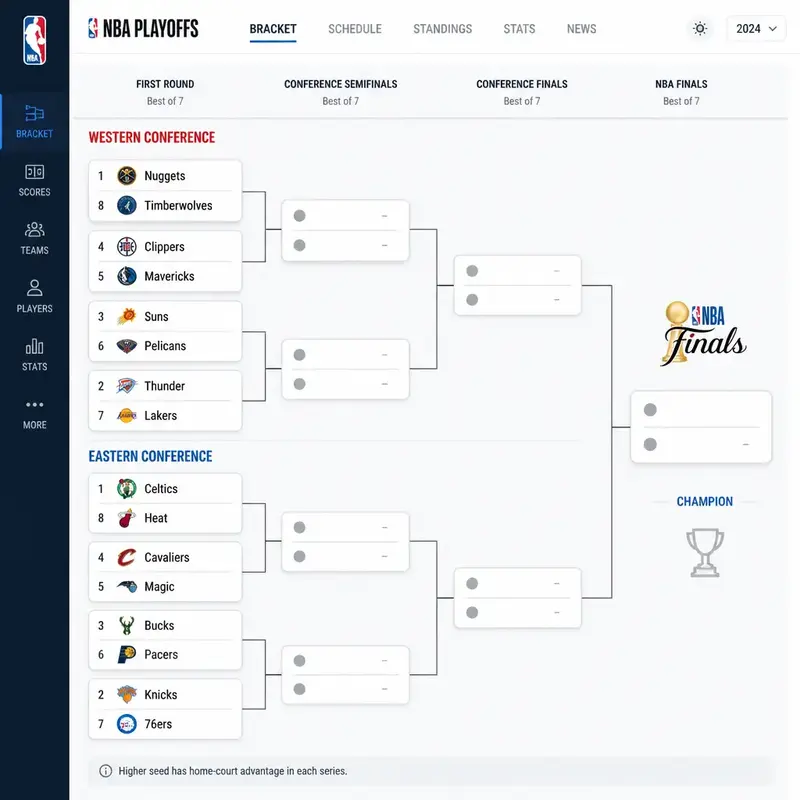
Step 5: Configure Game Scheduling Within the Bracket
Attach venue, date, time, and referee assignments to each bracket slot. This is where the bracket becomes an operational document rather than just a visual representation of matchups. Platforms that connect scheduling directly to the bracket eliminate the need to maintain a separate scheduling spreadsheet, which is a common source of version-control errors during a busy playoff week.
Live Scoring and Bracket Progression
The bracket is only useful if it stays current as games are played. A bracket that updates in real time, advancing the winning team automatically after each result is confirmed, is the difference between a tool your fans check once and a tool they follow throughout the playoffs.
NBA-Style In-Game Scoring
NBA-style live scoring means tracking points, fouls, timeouts, and quarter-by-quarter scores in real time, not just entering final scores after the game. When a platform supports this level of in-game data entry, the bracket receives results the moment a game ends rather than waiting for an administrator to manually update it after returning from the court.
This also generates a full statistical record for each playoff game automatically, including player-level statistics, which feeds into season-long stats and supports any post-season awards process your league runs.
OBS Streaming Overlays
For leagues that stream games, a live scoreboard overlay in OBS (Open Broadcaster Software) adds a broadcast-quality layer to your stream without requiring a separate graphics operator. Platforms that generate a browser source URL you can drop directly into OBS as a layer allow the scorer at the table to drive the on-screen graphics simply by operating the game scoring interface. There is no duplicate data entry. The score on the stream matches the score on the platform because they are the same data source.
Bracket Progression Without Manual Intervention
The moment a final score is confirmed, the winning team should advance in the bracket automatically. In a double-elimination structure, this also means the losing team routes correctly to the losers bracket without any manual action. Any platform that requires an administrator to manually advance teams through the bracket creates an unnecessary failure point, especially during a day when multiple games are finishing in close succession.
Communicating the Bracket to Teams and Fans
A well-structured bracket that nobody can find is not useful. Distribution is the step that league administrators most consistently underinvest in, and it shows in fan engagement numbers.
Shareable Live Bracket Links
Every team representative and every fan should receive a single link to the live bracket. Not a PDF. Not a screenshot. A link that updates as results come in. When someone opens that link during a playoff game and sees the results populating in real time, they bookmark it and come back. A static image shared to a group chat does not produce that behavior.
FIBA Box Score Integration
If your league uses certified FIBA scoresheets, the ability to import them as PDF files directly into your platform, rather than re-keying every statistic manually, is one of the highest-value features a basketball-specific platform can offer. It reduces post-game administrative time from potentially an hour per game to a few minutes, and it eliminates transcription errors that corrupt your statistics database over the course of a long playoff run.
Custom Branding Across All Fan-Facing Materials
The bracket your fans see should carry your league's name, logo, and color scheme. Generic third-party branding on your playoff bracket communicates that you are a customer of someone else's product rather than the organization running a professional competition. White-label capabilities, where each league within a platform maintains its own visual identity, matter more as your league grows its following and begins attracting sponsors who expect consistent brand presentation.
Frequently Asked Questions
What is the best bracket format for a 10-team basketball playoff?
For 10 teams in a single-elimination bracket, you need 2 first-round games to reduce the field to 8. The top 8 seeds receive the bracket positions, with seeds 9 and 10 playing in the first round. Seeds 1 and 2 receive automatic byes and enter in the second round. This structure rewards regular-season performance without requiring significantly more games than a clean 8-team bracket. If you have the schedule capacity for a longer event, a group-stage format with two groups of 5 feeding a 4-team knockout bracket is a stronger sporting option for 10 teams.
How do I handle a tie in seeding when two teams have the same regular-season record?
Apply your tiebreaker criteria in the order you published them before the season. The standard sequence is: head-to-head record between the tied teams, then each team's record against the highest-finishing common opponent (working down the standings), then point differential against each other in head-to-head games (with a per-game cap if you have one). If teams remain tied after all criteria are exhausted, a coin flip or random draw is acceptable, but the draw should be witnessed and documented. The key requirement is that the criteria are defined in advance, not invented to suit the outcome.
Can I use basketball playoff bracket software for a one-day tournament, or is it only for full leagues?
Purpose-built basketball platforms like bbstats.am are designed to handle both full multi-week leagues and single-day or weekend tournament events. The bracket, live scoring, and standings features operate independently from a long-format league setup. For a one-day event, you configure the bracket, run live scoring through the games, and the platform handles bracket progression automatically. The overhead of setup is lower than most administrators expect, typically under an hour for a standard 8 or 16-team event.
What is the difference between a seeded bracket and a random draw bracket?
In a seeded bracket, teams are placed in specific bracket positions based on their regular-season finishing position. The top seed is positioned to face the lowest-ranked qualifier in the first round, the second seed faces the second-lowest, and so on. This structure rewards teams for performing well in the regular season. A random draw bracket assigns teams to bracket positions without regard to regular-season performance. Random draws are occasionally used when all playoff participants are considered peers in terms of ranking, but in a league context with a meaningful regular season, seeded brackets are the standard and the correct choice.
How does live bracket progression work in practice during a tournament day?
In a platform with properly connected live scoring and bracket management, the scorer at the table enters points in real time throughout the game. When the final buzzer sounds and the final score is confirmed, the platform marks the game as complete, records the winning team, and automatically advances that team to the next bracket slot. In a double-elimination format, it simultaneously routes the losing team to the correct position in the losers bracket. Administrators watching the bracket on a separate screen see this happen within seconds of game confirmation, without any manual action required.
Do I need technical expertise to set up playoff brackets on a platform like bbstats.am?
No. Platforms designed for league administrators, not developers, handle the technical structure internally. You configure the number of teams, choose your format, apply your seeding, and the bracket is generated. Connecting live scoring to the bracket, enabling OBS streaming overlays, or importing FIBA PDF box scores are all features designed to be operated by sports administrators without engineering backgrounds. The value of a sports-specific platform is precisely that it removes the need for technical expertise from the daily workflow.
If you have managed a basketball playoff bracket, whether with software or a spreadsheet, share what worked and what you would do differently. Your experience helps other administrators avoid the same early mistakes.