
Running a basketball playoff without the right bracket software is a guaranteed recipe for chaos. Seedings get disputed, bracket updates lag behind the action on the court, and fans are left refreshing a static PDF that was already wrong before the first game tipped off. If you organize a basketball league or championship, you have probably experienced at least one of these failures firsthand. Basketball playoff bracket software solves all three problems simultaneously, but only when it is configured correctly from the start. This guide walks you through every decision you need to make, in the right order, before your playoff begins.
Table of Contents
- Quick Takeaways
- Why Playoff Bracket Management Fails (and What Actually Fixes It)
- Choosing Your Bracket Format Before You Touch Any Software
- Platform Comparison: What Your Options Actually Offer
- Setting Up Your Bracket Step by Step
- Best-of Series Bracket Management: The Details That Break You If You Ignore Them
- Live Scoring and Fan Engagement During the Playoffs
- Streaming Overlays and Broadcast Presentation
- Frequently Asked Questions
- References
Quick Takeaways
| Key Insight | Explanation |
|---|---|
| Seeding logic must be locked before bracket creation | Entering seeds into any software before your seeding rules are finalized will force manual corrections that corrupt the automated bracket progression. |
| Best-of series require a different data model than single-game brackets | Software that only tracks single-game results cannot handle a best-of-three or best-of-five series without manual workarounds that break public-facing displays. |
| Automated bracket advancement eliminates the most common organizer error | When a platform automatically advances the series winner, you remove the single biggest source of playoff bracket mistakes: manual score entry errors. |
| Fan-facing bracket URLs need to be shared before the playoffs start | Sending fans a public bracket link after Round 1 tips off means they miss the narrative. Share the seeded bracket the moment it is set. |
| Custom branding on bracket pages drives perceived league professionalism | A bracket on your own domain with your league colors and logo communicates seriousness to sponsors, players, and fans in a way a generic third-party URL never will. |
| FIBA-style play-by-play data is worth collecting even in amateur leagues | Play-by-play logs allow post-playoff statistical analysis, dispute resolution, and replayable game timelines that raise the quality of your league records permanently. |
| OBS streaming overlays connected to live bracket data are now achievable without a broadcast crew | Platforms that push live scores directly to OBS overlays allow a single organizer to run a professional-looking stream without a separate stats operator. |
Why Playoff Bracket Management Fails (and What Actually Fixes It)
The most common failure mode is not a software problem at all. It is an organizer who tries to configure the bracket while the playoff is already in progress. By the time Game 1 of Round 1 is done, there is no time to figure out how automatic advancement works. The pressure of the moment causes manual entry, and manual entry causes mistakes.
The second most common failure is using a tool designed for single-elimination brackets to run a best-of series playoff. Single-game bracket builders like Challonge are fast and easy for weekend events, but they do not have a concept of "series score." Every game in a best-of-three has to be entered as a separate bracket stage, which means your public-facing bracket never reflects the actual series standing. Fans see noise, not progress.
The fix is preparation and platform fit. Choose software that natively supports your exact bracket format, complete the full setup including seeds, tiebreakers, and series length before any games are played, and publish the bracket publicly the moment seeding is finalized. Everything after that should be automated.
Pro tip: Run a full dry-run simulation of your playoff bracket at least one week before it starts. Enter fake scores, advance teams through rounds, and confirm that the public-facing display updates correctly. If anything breaks in the dry run, you have time to fix it without anyone watching.
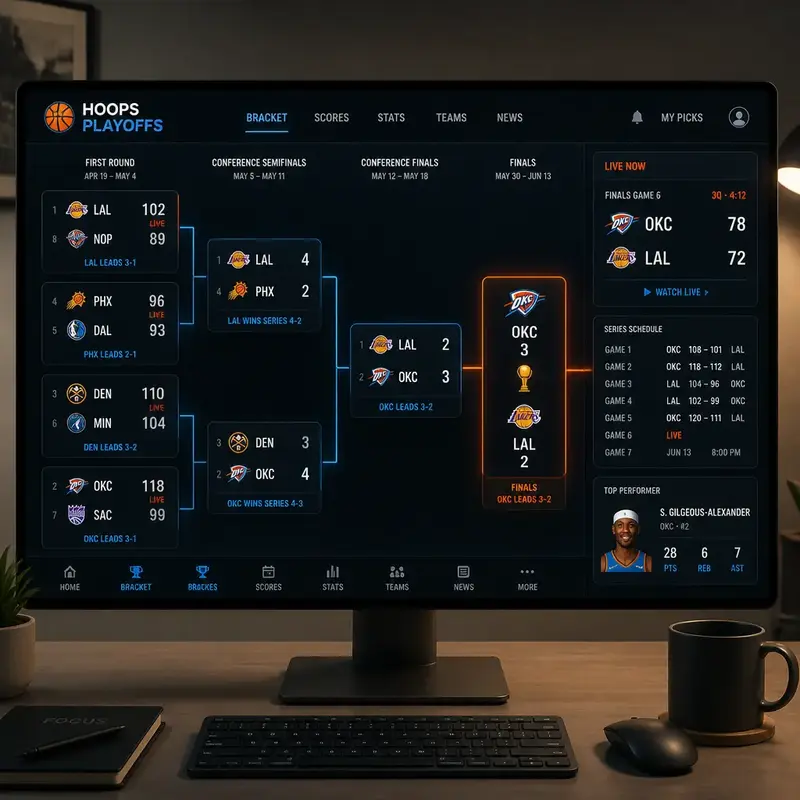
Best-of Series Bracket Management: The Details That Break You If You Ignore Them
Best-of series bracket management introduces complexity that single-game formats do not have. The three areas where organizers consistently run into trouble are series advancement logic, home-court alternation, and bye handling when a higher seed has already clinched.
Series Advancement Logic
Your software needs to know when a series is over. In a best-of-five, the first team to win three games advances. If your platform does not track cumulative series wins per team, it cannot make this determination automatically. You will end up entering the result manually, which defeats the purpose of using software for bracket management. Confirm this feature is native before committing to a platform.
Home-Court Alternation
In a best-of series, the higher seed typically hosts Games 1, 2, and 5, with the lower seed hosting Games 3 and 4. This scheduling needs to be visible to both teams well in advance. Platforms that display the full series schedule including tentative game dates for games that may not be needed (Games 4 and 5 in a best-of-five, for example) allow coaches and facilities to plan ahead without waiting on the organizer to communicate after each game.
Early Series Clinch and Remaining Game Handling
When a team wins a best-of-three in two straight games, the third game does not get played. Your bracket software needs to cleanly handle this: it should mark the series as complete, advance the winner, and remove the scheduled Game 3 from any calendar or public schedule view without leaving a ghost entry that confuses fans or facility managers.
The difference between a bracket tool and a league management platform is whether the system understands the outcome or just records the score. For best-of series management, that distinction decides whether your playoff runs smoothly or requires constant manual intervention.
Live Scoring and Fan Engagement During the Playoffs
Fans engage with a playoff bracket differently than they do with a regular season standings table. During the playoffs, they want to know the current score of a game in progress, the current series standing, and who wins next if this team or that team advances. All three of these experiences depend on real-time data flowing from the scoring table to a public-facing display.
A platform with NBA-style play-by-play tracking gives you two things that a simple score entry system does not. First, it provides a second-by-second game log that fans can follow from their phones even if they cannot be at the venue. Second, it generates statistical outputs (points per quarter, individual player scoring lines, team shooting splits) that give the playoff narrative depth and give fans something to discuss and share between games.
The fan engagement benefit of real-time bracket updates is concrete. When a fan can see the bracket update the moment the final buzzer sounds and a new matchup appears in the next round, the platform becomes part of the playoff experience rather than just an administrative tool. That emotional connection to the bracket is what makes fans follow a league across multiple seasons.
For bbstats.am users, the public fan page updates in real time as play-by-play data is entered at the scorer's table. No manual refresh needed on the organizer side. The bracket advances automatically when a series is decided, and the next-round matchup appears for fans immediately.
Streaming Overlays and Broadcast Presentation
Basketball playoff streams have higher viewership than regular season games in almost every league that tracks this. If your league streams any games, the playoffs are the moment to present the broadcast professionally. The two elements that make the biggest visible difference are a live scoreboard overlay and a bracket graphic that updates during or between games.
OBS (Open Broadcaster Software) is the standard tool that amateur and semi-professional basketball streams use. Platforms that push live score and bracket data directly to OBS browser sources allow a single person operating the stream to maintain a professional on-screen presentation without a separate stats operator feeding data. The score overlay updates automatically as play-by-play data is entered, which means the viewer sees the current score at all times without anyone manually changing a graphic.
This is not a feature that general bracket builders or sports registration platforms like LeagueApps or SportNinja typically include. It is a basketball-specific production capability that distinguishes platforms built for the sport from those built for sports administration in general. For a league that takes its broadcast presentation seriously, the presence or absence of OBS overlay integration is a decisive factor in platform selection.
Beyond live overlays, consider how your bracket is presented in a broadcast context. A bracket graphic that you can pull up as a full-screen element between games, showing current series scores, upcoming matchups, and remaining teams, turns a dead air moment into useful content for viewers. If your platform generates this automatically from live data, you eliminate the design work that would otherwise fall on whoever is running the stream.
Frequently Asked Questions
What is the difference between a bracket builder and basketball playoff bracket software?
A bracket builder creates and displays a visual bracket structure and records results. Basketball playoff bracket software does all of that and also manages series scores across multiple games, tracks play-by-play data within each game, handles automated bracket advancement when a series is won, and delivers real-time updates to a public fan page. For a one-day single-elimination tournament, a bracket builder may be sufficient. For a multi-round best-of series playoff, you need software built specifically for that format.
How many teams can a typical online tournament bracket basketball platform handle?
Most dedicated basketball league platforms handle anywhere from four teams to sixty-four teams or more in a bracket. The more important question is not the raw team count but whether the platform supports your specific format. A sixteen-team bracket with best-of-three first-round series followed by best-of-five semifinals and finals is a specific data structure. Confirm your platform supports that exact configuration, including automatic series advancement at each round, before committing to it.
Can I run a playoff bracket with custom branding on my own domain?
Yes, some basketball league platforms support white-label or custom domain deployment, which means your bracket, standings, and game pages appear under your own URL rather than a generic third-party subdomain. This matters for sponsor visibility and for the perception of your league's professionalism. Platforms like bbstats.am are built around this model, where each league operates its own branded instance rather than being one anonymous tournament on a shared platform.
What happens if a game score is entered incorrectly during the playoffs?
This depends entirely on the platform. Good basketball playoff software allows administrators to correct scores and will automatically recalculate series standing and bracket advancement based on the corrected result. Poor platforms lock results after entry or require you to contact support to make changes. Test this before your playoff starts. Enter a result, then correct it, and confirm the bracket updates properly. If it does not, find a different platform.
How do I handle a tie in a playoff series bracket when two teams are even on series wins?
A tied series is not actually a bracket problem, it is a series-in-progress state. If you are mid-series and both teams have won the same number of games, the series continues to the next game. The bracket should not advance until a team reaches the win threshold for the series. Where this becomes a real software issue is when a platform tries to resolve a series before it is finished, which typically happens with poorly designed automatic advancement logic. A correctly configured platform holds the bracket at the current state until the series is decided.
Is FIBA PDF export useful for amateur basketball leagues, or is it only for professional competitions?
FIBA-format game sheets are useful for any league that wants a standardized, official-looking record of each game. They include official box scores, team rosters with player numbers, and game officials. For amateur leagues that want to present themselves professionally to sponsors, players, or governing bodies, being able to export a FIBA-compliant PDF after every playoff game is a meaningful credibility signal. It also creates a permanent record that is far more useful for historical tracking than a screenshot of a scoreboard.
If you have run a basketball playoff with dedicated bracket software and have feedback on what worked or what caught you off guard, sharing your experience helps other organizers make better decisions before their playoffs begin.