
Your league's games are happening right now, and the only person who knows the score is the scorekeeper scribbling on a clipboard. Parents in the parking lot are texting for updates. Coaches are disputing stats nobody can verify. Fans who drove two hours to watch their team play last week have no idea who won. If this sounds familiar, you are running your basketball league without a live basketball scoring platform, and you are paying for it in wasted time, frustrated stakeholders, and a product that looks amateur no matter how competitive your play actually is. This guide explains exactly what these platforms do, what separates a purpose-built solution from a generic workaround, and how to choose the right tool for your league's specific needs.
Table of Contents
- Quick Takeaways
- What Is a Live Basketball Scoring Platform
- Core Features That Actually Matter
- Why Real-Time Basketball Scoring Changes Fan Engagement
- Platform Comparison: Dedicated Scoring vs. General League Tools vs. DIY
- OBS Streaming Overlays for Basketball Leagues
- Basketball League Technology for Tournament and Playoff Management
- Common Mistakes League Organizers Make When Choosing Technology
- Frequently Asked Questions
- References
Quick Takeaways
Key Insight | Explanation |
|---|---|
Live scoring is not just a scoreboard | A real platform tracks play-by-play events, player stats, fouls, timeouts, and quarters, not just the final score. |
Fan access drives league growth | Remote fans, family members, and sponsors need a public-facing URL where they can follow games live, without creating accounts. |
OBS overlay integration separates professional from amateur | Leagues that stream games need score overlays that update automatically when a scorekeeper taps an event, not manual graphic edits mid-game. |
Automated brackets eliminate organizer errors | Playoff bracket management that seeds teams automatically from standings removes a major source of complaints and manual rework. |
Custom branding is a revenue and credibility tool | Your own domain and logo on the platform signals professionalism to sponsors, teams, and players, which generic platforms running their own branding undermine. |
FIBA PDF integration saves hours of post-game work | Platforms that export standard FIBA scoresheets automatically eliminate manual data re-entry and reduce disputes after games. |
General sports tools are not built for basketball stats | Basketball-specific tracking (assists, blocks, steals, personal fouls, technical fouls) requires a platform designed around basketball, not adapted from soccer or hockey. |
What Is a Live Basketball Scoring Platform
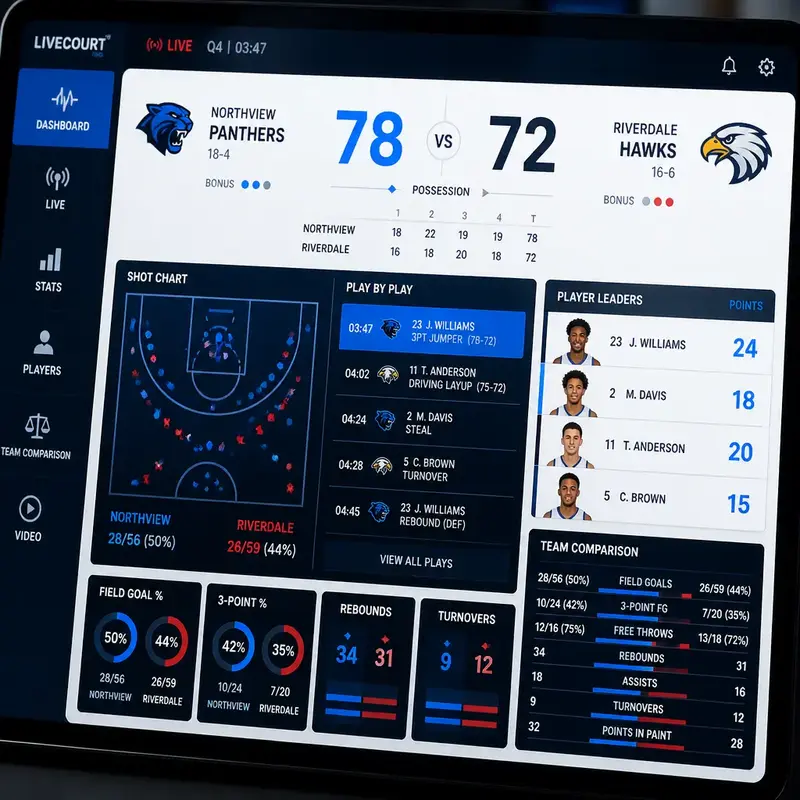
A live basketball scoring platform is a software system that lets a designated scorekeeper enter game events in real time, broadcasts those updates immediately to a public-facing website, and stores every event as structured data for stats, standings, and reporting. The key word is "real time." The output is not a score updated at halftime or entered manually after the game. It is a running feed of every basket, foul, timeout, and substitution, available to anyone with a link the moment the action happens.
The distinction matters because most league organizers start with tools that were never designed for this. Google Sheets updated by hand, WhatsApp groups broadcasting score updates, and free website builders with static game results are the standard DIY stack. This approach means juggling Google Sheets, WhatsApp groups, and a free website builder instead of running a single system that handles everything from the scorekeeping tablet to the public leaderboard. The friction is constant, the error rate is high, and the experience for fans and teams is poor.
A purpose-built platform replaces that entire stack. The scorekeeper uses a tablet or phone interface to log events during the game. The platform processes those events, updates standings, calculates player stats, advances brackets, and serves a live feed to every fan who has the league's URL open on their phone. None of that requires manual work from the organizer after setup.
Play-by-Play vs. Score-Only Systems
There is a meaningful difference between a system that records a running score and one that logs individual play-by-play events. Score-only systems let a scorekeeper tap "plus two" and publish a number. Play-by-play systems log which player scored, from where, at what game clock time, and in what quarter. That granularity is what produces real player stats: points, rebounds, assists, steals, and blocks tracked per player, per game, per season.
For recreational leagues, score-only may be sufficient. For competitive leagues, semi-professional leagues, and any league where teams and agents review player performance, play-by-play tracking is not optional. It is also the foundation for streaming overlays that display real stats on broadcast, not just a score bug.
Pro tip: Before choosing any platform, ask whether it records individual play events or only aggregate scores. The answer determines whether you can produce per-player season stats, game logs, or FIBA-compliant scoresheets at the end of each game.
Core Features That Actually Matter
Every platform in this space lists a long set of features. Most of them are table stakes. The features that actually differentiate a platform in day-to-day league operations are narrower than the marketing suggests, and they are the ones that break down under pressure during a live game or a playoff weekend.
Real-Time Stat Tracking Built for Basketball
Basketball leagues need bracket generation for tournaments, detailed stat tracking including points, rebounds, assists, steals, and blocks, gym scheduling with court assignments, and often live scoring that keeps remote fans and family members engaged. That list is specific to basketball. Platforms adapted from soccer or hockey management tools almost always have gaps here, particularly around foul tracking, technical fouls, and quarter-by-quarter breakdown data.
A basketball-specific platform will have scoring modes that account for two-point baskets, three-point baskets, free throws, personal fouls (with bonus and double-bonus tracking), timeouts per quarter, and substitutions. A generic sports platform will have "score" and "penalty," which is not the same thing.
Public Fan-Facing Access Without Account Requirements
One of the most overlooked requirements in league technology is the question of who can see the live score and how. Platforms that require fans to create an account, download an app, or request access kill the casual fan experience entirely. The parent watching from the parking lot, the player who is injured this season and following from home, the sponsor checking game results on a Friday night: none of these people will jump through a registration wall.
A live scoring platform worth using gives your league a public URL where any person with the link can follow scores, standings, and stats in real time, without any login. This is not a minor convenience. It is the primary mechanism through which fans engage with your league between games.
Automated Standings and Bracket Advancement
SportNinja enables full stats scoring, attendance checking directly from the app, and through live sync across platforms, scores and standings can be accessed in real time. The automation component is critical: standings should recalculate automatically after each game result is confirmed. Playoff brackets should advance automatically when a series result is entered. Any platform that requires an administrator to manually update a bracket or recalculate standings is adding avoidable work and avoidable errors to every game week.
Pro tip: Test any platform's bracket logic before your playoff season begins. Enter a series of dummy results and confirm that seeds, tiebreakers, and bracket advancement work correctly for your specific tournament format. Problems discovered during an actual playoff are far more costly than problems found in a dry run.
Why Real-Time Basketball Scoring Changes Fan Engagement
The argument for real-time basketball scoring is not just operational efficiency. It is a fundamental shift in what your league means to the people who follow it. A league with live scores is a league people check on their phones during the day. A league without live scores is a league people forget about between games.
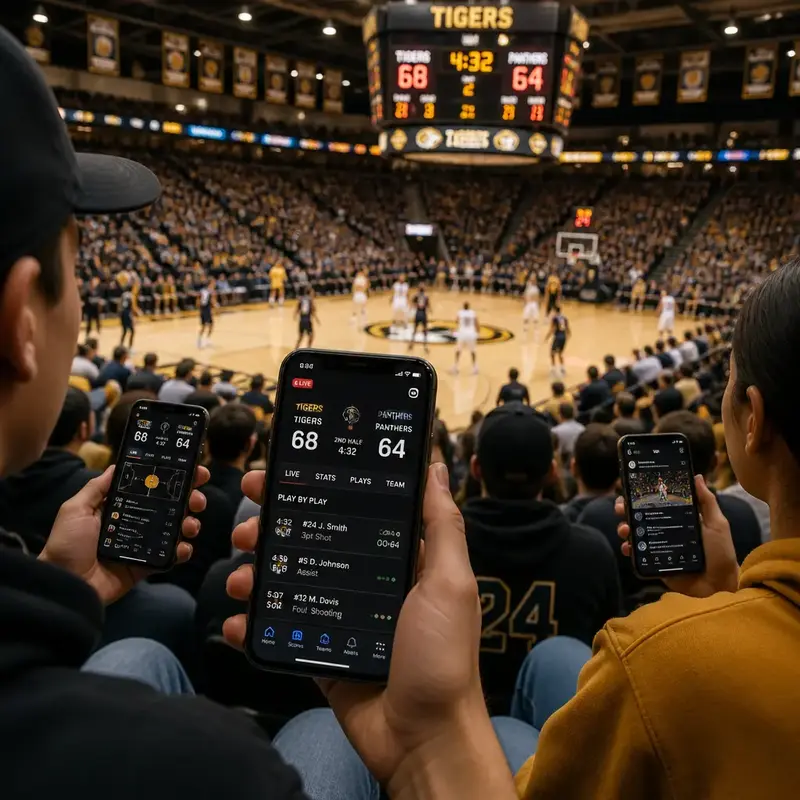
The reality is that 99% of NBA fans will never attend a live game, and this dynamic applies directly to local and regional leagues. The audience for any basketball league is always larger than the crowd in the gym. Former players, family members outside the city, sponsors who cannot attend games, media contacts, and prospective recruits are all potential audience members who can only participate if you give them a way to follow the action remotely.
When a fan opens your league's URL and sees a live play-by-play feed updating in real time, the perception of your league changes immediately. It signals organization, investment, and professionalism. When that same fan gets to the website and sees a static table of game results last updated two days ago, the signal is the opposite.
The Sponsor Visibility Argument
Sponsors pay for eyeballs. A league that runs live scoring generates a page that fans visit repeatedly during game days, not just once to check a schedule. That page is where sponsor logos, banners, and acknowledgments belong. A live-scoring platform with custom branding on a league's own domain gives sponsors a visible, measurable presence in front of an active audience rather than a logo on a jersey that disappears after the game.
This is a direct business case for technology investment. The incremental cost of running a live scoring platform is recoverable through a single mid-tier sponsorship deal made possible by the visibility that platform creates.
Platform Comparison: Dedicated Scoring vs. General League Tools vs. DIY
The market for basketball league technology broadly divides into three categories: dedicated scoring and stats platforms built specifically for basketball, general sports league management tools that include basic scoring features, and DIY approaches using spreadsheets plus communication tools. Each has a real place, but the fit depends on your league's scale, ambition, and the quality of experience you are trying to deliver.
Approach | Best For | Key Limitations |
|---|---|---|
Dedicated basketball scoring platform (e.g., bbstats.am) | Competitive leagues, championships, semi-pro tournaments requiring play-by-play stats, OBS overlays, FIBA PDFs, custom branding, and automated playoff brackets | Higher setup investment than free tools; requires scorekeepers to learn the interface |
General sports league management (e.g., LeagueApps, SportNinja) | Organizations that primarily need registration, payments, scheduling, and basic communication; SportNinja dedicates itself to helping sports leagues streamline operations with technology and automation, offering tools that are free for participants | Live scoring is secondary to admin tools; basketball-specific stat depth is limited; branding is often the platform's own, not the league's |
DIY (Google Sheets, WhatsApp, free website builder) | Very small, informal leagues with no budget and no expectation of a professional product | No real-time capability; error-prone; no automatic standings or brackets; zero fan-facing polish; does not scale past a handful of teams |
The practical reality is that platforms like LeagueApps and SportNinja are built around the administrative layer: LeagueApps streamlines tasks such as registrations, payments, schedules, and communication. Live scoring and deep basketball stats are often add-ons or afterthoughts in those systems, not their core architecture. For a league organizer who treats the live game experience as the product, this is a critical gap.
If your league is already satisfied with your current website but needs a live game management tool, SportNinja is worth considering, according to one independent review, but that framing itself reveals the tool's positioning: it is a supplement to an existing setup, not a full platform replacement.
OBS Streaming Overlays for Basketball Leagues
Streaming basketball games is increasingly common at the competitive amateur and semi-professional level. The difference between a stream that looks professional and one that looks like a phone propped on a bleacher often comes down to a single feature: the live score overlay. A score overlay (also called a scorebug) sits on top of the video feed and shows the score, quarter, game clock, fouls, and timeouts for both teams.
Platforms that integrate with OBS work by letting you paste a URL into OBS as a browser source. The scorebug overlays your stream and updates the second you tap a scoring event. This is the correct architecture. The scorekeeper is focused on logging events accurately in the scoring platform. The stream receives those updates automatically without any separate operator managing graphics.
What to Look For in a Streaming Integration
When setting up a basketball scoreboard overlay in OBS, proper sizing matters: 1800px width for 1080p streams, with careful positioning so you do not block game action. A dedicated scorekeeper is strongly recommended during the game. These are practical requirements that most platform documentation skips. The scorekeeper cannot also be watching the stream, adjusting graphics, and running the camera simultaneously. The technology needs to handle the overlay automatically.
Platforms that require a separate operator to manually update an OBS graphic file every time a basket is scored are not streaming solutions. They are a continuous distraction from game coverage. A real integration means the score on the stream and the score in the platform are always the same number, updated by a single tap.
bbstats.am delivers this through browser-source overlays designed for OBS, with branding that matches your league's colors and logos, not generic template graphics. That detail matters when sponsors are watching the stream and the overlay is the most visible branded surface in the production.
Basketball League Technology for Tournament and Playoff Management
The regular season and the postseason have different operational demands. Regular season management is primarily about consistency: games happen, scores are entered, standings update. Playoff management is about bracket logic, seeding rules, tiebreakers, and advancement, all of which need to happen correctly and quickly, often with multiple games happening in parallel on the same day.
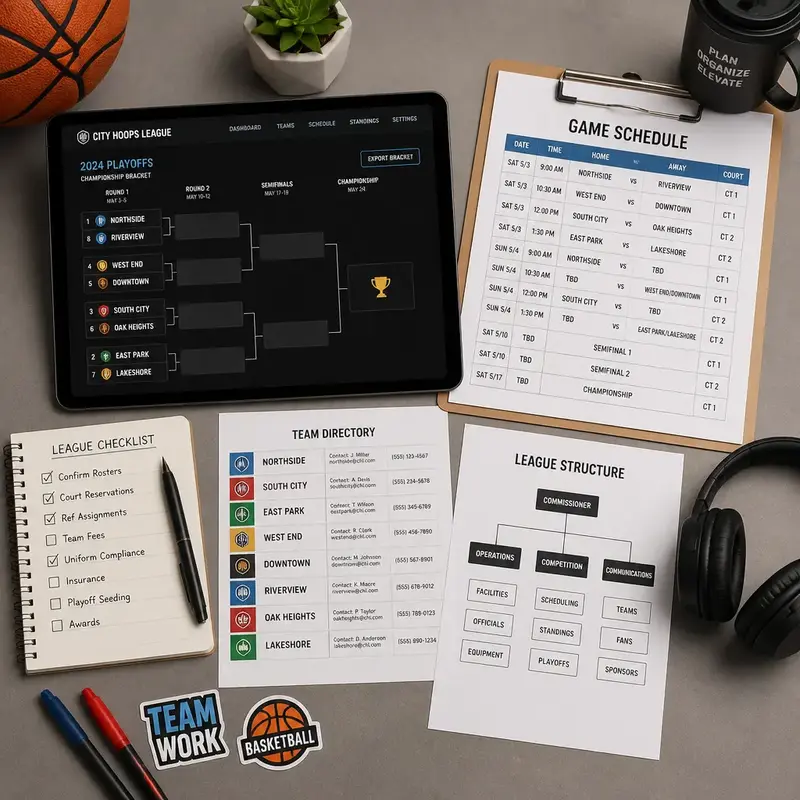
Manual bracket management using an image file or a printed bracket board fails exactly when you need it most: when a game ends and twelve other stakeholders immediately want to know who the next opponent is and when the game will be played. Basketball league technology that automates this process means the bracket updates on the public page the moment a result is confirmed, and every team, coach, and fan sees the update simultaneously.
FIBA PDF Integration and Official Record-Keeping
Leagues operating under FIBA affiliation or following FIBA-standard rules have a specific documentation requirement: the official game scoresheet must be produced in the correct format after every game. Doing this manually by transcribing play-by-play data from a tablet into a PDF template is slow, error-prone, and a significant administrative burden across a full season.
A platform with native FIBA PDF export generates this document automatically from the play-by-play data already collected during the game. The scorekeeper does not re-enter anything. The official document is a direct output of the live scoring data, which also means it is accurate and defensible if any game result is disputed.
This single feature eliminates a class of post-game administrative work that consumes league staff time every game day and replaces it with a one-click export. For federations running dozens of games per week, that adds up to several hours of saved work across a season.
Common Mistakes League Organizers Make When Choosing Technology
After examining the landscape of basketball league technology, the same mistakes appear repeatedly among organizers who invest in software and then find themselves still managing parts of the operation manually.
Choosing Registration Software When You Need Scoring Software
The most common mistake is treating league management as primarily an administrative problem (registrations, payments, scheduling) and choosing a tool optimized for those tasks. Registration software does not produce a live game experience. It produces a well-organized team roster. Those are different products solving different problems. A league that has excellent payment processing and zero live scoring capability has solved the wrong half of the problem for fan engagement.
Using a Platform That Brands Itself, Not Your League
Many general sports platforms host your league on their domain with their branding. Your league's URL is something like genericsportsplatform.com/your-league-name. Every fan who visits that URL is reinforcing the platform's brand, not yours. Sponsors paying for visibility are seeing a competitor's product name, not your league's name. Custom domain and branding are not luxury features. They are the foundation of a professional league identity.
Underestimating the Scorekeeper Training Requirement
A live basketball scoring platform is only as good as the person entering data during the game. Platforms with poor mobile interfaces, slow response times, or confusing event entry flows will produce inaccurate stats and frustrated scorekeepers. Before committing to any platform, have your actual scorekeepers test the interface under game-speed conditions. A system that looks elegant in a demo and falls apart under pressure during a fast fourth quarter is not fit for purpose.
The scorekeeping interface is not a back-office tool. It is the live input surface for every piece of data your platform produces. If it fails during a game, everything built on top of it, the stats, the overlays, the brackets, fails with it.
Ignoring the Public-Facing URL Experience
Live scoring keeps remote fans and family members engaged, but only if the public-facing experience is actually good. Organizers sometimes invest in backend tooling and neglect the page that fans actually see. A league's public website, with live scores, player stats, standings, and bracket progression, is its product to the outside world. It should be designed for a fan on a phone, not an administrator on a desktop.
Frequently Asked Questions
What is the difference between a live basketball scoring platform and a sports league management tool?
A sports league management tool focuses on administrative tasks like team registration, payment collection, scheduling, and communication. A live basketball scoring platform focuses on the game itself: real-time play-by-play entry, player stat tracking, public score broadcasting, and post-game records. Some platforms attempt to do both, but purpose-built scoring platforms like bbstats.am deliver significantly deeper basketball-specific functionality in the game-day layer than general management tools do.
Do fans need to create an account to follow live scores?
On a well-designed platform, no. Fans should be able to follow live scores, standings, and player stats through a public league URL without any registration. Requiring account creation before showing a score is a friction point that reduces audience reach and makes your league less accessible to casual followers. If a platform requires fan registration to view live data, that is a product design choice working against your league's interests.
How does an OBS streaming overlay connect to a live scoring platform?
The standard integration works through a browser source in OBS. The scoring platform generates a URL that displays a formatted score overlay. You paste that URL into OBS as a browser source, position it on the video feed, and from that point forward the overlay updates automatically every time the scorekeeper logs an event in the platform. No separate graphics operator is needed. The scorekeeper's input drives both the platform data and the on-stream display simultaneously.
What is a FIBA PDF and why do basketball leagues need it?
A FIBA PDF is the standardized official game scoresheet format used under FIBA rules and by many national federations affiliated with FIBA. It records every scoring event, foul, timeout, substitution, and player on both rosters in a specific format. Leagues that operate under FIBA standards or want to maintain official game records in a recognized format need to produce this document for every game. Platforms with FIBA PDF integration generate it automatically from live scoring data, eliminating manual transcription after each game.
How is bbstats.am different from LeagueApps or SportNinja for basketball leagues?
LeagueApps and SportNinja are built primarily around league administration and general sports management, with live scoring as a secondary feature. bbstats.am is built specifically for basketball championships and leagues, with NBA-style play-by-play tracking, automated playoff brackets, FIBA PDF export, custom domain and branding, and OBS-compatible streaming overlays as core features, not add-ons. For a league organizer whose primary product is the game experience rather than registration processing, the difference in depth is significant.
How much does a live basketball scoring platform typically cost?
Pricing varies across the market. Some platforms offer entry-level tiers starting at modest monthly fees, while full-featured platforms with custom branding, streaming overlays, and FIBA integration are typically priced for professional or semi-professional league use. The relevant comparison is not the subscription cost in isolation but the cost relative to what it replaces: staff hours spent on manual data entry, post-game disputes from inaccurate records, and the lost sponsorship revenue that comes with a non-professional public presence.
Can a single scorekeeper manage both play-by-play entry and streaming overlay during a live game?
Yes, when the platform is properly integrated with OBS via a browser source, the scorekeeper's single input drives both the stats platform and the stream overlay simultaneously. The scorekeeper focuses on logging events accurately. The stream updates automatically. No additional operator is required for the graphics. This is one of the practical advantages of a platform with native streaming integration over a manual graphics workflow where someone has to update a scoreboard file by hand during the game.
If you are currently running a basketball league with any of the pain points described here, share your experience below. What is the specific gap in your current setup that is causing the most friction, and what have you tried to solve it?