
If your league is still posting final scores in a WhatsApp group two hours after the buzzer, you are not running a modern basketball operation. You are running a filing system. NBA-style live scoring for amateur basketball is no longer a luxury reserved for professional franchises with broadcast teams. The technology is accessible, the expectation from players and fans has already shifted, and the leagues that deliver real-time data are the ones building loyal followings while everyone else watches attendance slowly erode. This article breaks down exactly what NBA-style live scoring means at the amateur level, what it actually takes to implement it, and why it matters more than most administrators realize.
Table of Contents
- Quick Takeaways
- What NBA-Style Live Scoring Means for Amateur Leagues
- The Core Components of a Live Scoring Setup
- Why Amateur Leagues Cannot Afford to Ignore This
- Live Scoring vs. Manual Score Reporting: A Direct Comparison
- How BBStats Delivers NBA-Style Scoring for Local Leagues
- OBS Overlays and Live Streaming: The Broadcast Layer
- Frequently Asked Questions
- References
Quick Takeaways
| Key Insight | Explanation |
|---|---|
| Live scoring is about real-time data, not just a visible scoreboard | True NBA-style scoring tracks points, fouls, timeouts, quarters, and player stats as the game unfolds, not after it ends. |
| Fan engagement depends on immediacy | Fans following from home or another venue need score updates the moment a basket is scored, not a delayed summary post. |
| OBS overlays turn any stream into a broadcast | A live scorebug embedded into a streaming setup makes amateur games look and feel like televised fixtures, which attracts more viewers and sponsors. |
| FIBA-compliant box scores save officials hours of paperwork | Platforms that generate or import FIBA PDF box scores eliminate manual stat compilation and reduce transcription errors. |
| Standings and brackets update themselves | When scoring feeds directly into league standings and playoff brackets, administrators stop spending Sunday evenings updating spreadsheets. |
| White-label branding signals professionalism | A league that presents its own branded scoring page builds trust with players, parents, and potential sponsors far faster than a generic third-party link. |
| One scorer, one phone, zero technical expertise required | Modern basketball live scoring platforms are designed so a single person at the scorer's table can manage the entire game log from a smartphone. |
What NBA-Style Live Scoring Means for Amateur Leagues
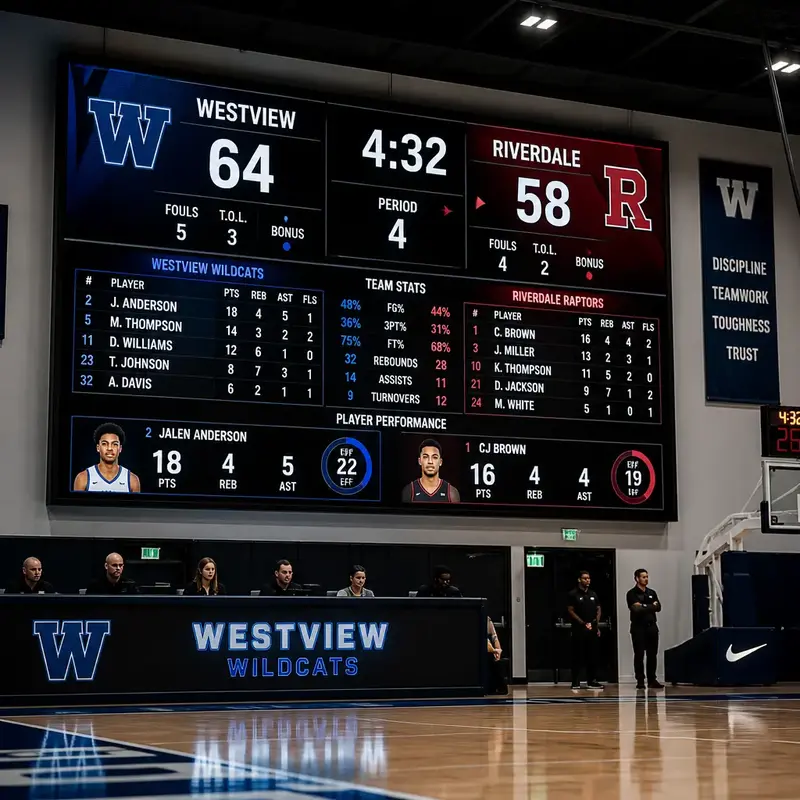
The phrase "NBA-style live scoring" can sound like marketing language, but it points to a very specific set of features. At the professional level, every basket, foul, timeout, and substitution is logged the moment it happens, fed into a central database, and pushed simultaneously to broadcast graphics, official records, league standings, and fan-facing apps. The same data event powers the arena scoreboard, the TV overlay, and the website simultaneously.
For an amateur league, replicating that exact infrastructure at full scale is not the goal. The goal is functional parity: ensuring that the moment a basket goes in, someone at the scorer's table logs it on a device, and that action automatically updates the live score visible to fans, feeds into player statistics, and contributes to the official game record. No delay, no separate data entry step, no manual standings update on Monday morning.
What separates NBA-style systems from basic scoreboards is the depth of the data layer. A simple scoreboard shows the score and the clock. An NBA-style platform captures who scored, what type of shot it was, which quarter it happened in, what the foul situation is, and how many timeouts remain. That data then drives box scores, player rankings, team efficiency stats, and historical league records.
Pro tip: When evaluating any amateur basketball live scoring platform, ask one question: does scoring a basket in the app automatically update the standings page, the player stat leaderboard, and the live score feed at the same time? If the answer requires any manual step, it is not a true live scoring system.
Administrative Efficiency
In practice, the biggest argument for live scoring is the time it saves the people running the league. Consider the typical workflow without it: scorer keeps manual stats on paper, photographs them after the game, someone transcribes them into a spreadsheet, someone else updates the standings document, someone posts the results. That chain involves multiple people, introduces transcription errors at every step, and takes hours. A live scoring platform collapses that entire chain into the scorer's real-time input during the game itself.
Pro tip: Track how many hours per game week your admin team currently spends on score entry, standings updates, and communicating results. Even a conservative estimate usually reveals enough wasted time to justify adopting a dedicated platform within the first month of a season.
Live Scoring vs. Manual Score Reporting: A Direct Comparison
The practical differences between live scoring and manual reporting are significant enough to warrant a direct side-by-side view. The comparison below addresses three approaches that amateur leagues actually use.
| Approach | What It Delivers | Where It Falls Short |
|---|---|---|
| Manual entry (spreadsheet + social post) | Zero platform cost, no setup required, familiar to everyone | Hours of admin work per game week, no real-time access for fans, no player stats, prone to transcription errors, no exportable box scores |
| Generic scoreboard app (e.g., a simple scoreboard widget) | Shows a live score during the game, easy to set up on a tablet or TV, low cost | No player-level stats, no automatic standings updates, no FIBA box score export, no fan-facing URL, no OBS broadcast integration, data disappears after the game |
| Dedicated basketball live scoring platform (e.g., BBStats) | Real-time per-player stats, automatic standings and bracket updates, FIBA PDF box score export, OBS streaming overlays, fan-facing league pages, custom branding per league | Requires initial setup and scorer training, subscription cost (offset by admin time saved) |
The generic scoreboard app is a step up from nothing, but it is not a league management tool. It solves the in-venue display problem while doing nothing for the administrative burden or the fan experience outside the gym. A purpose-built platform for amateur basketball live scoring handles both simultaneously.
How BBStats Delivers NBA-Style Scoring for Local Leagues
BBStats is built specifically for the administrator who needs professional-grade basketball operations without a professional-grade budget or a technical team. The platform's scoring interface is designed for a single scorer operating from a smartphone at the table, logging every basket, foul, rebound, and timeout as the play happens.
Real-Time Score Distribution
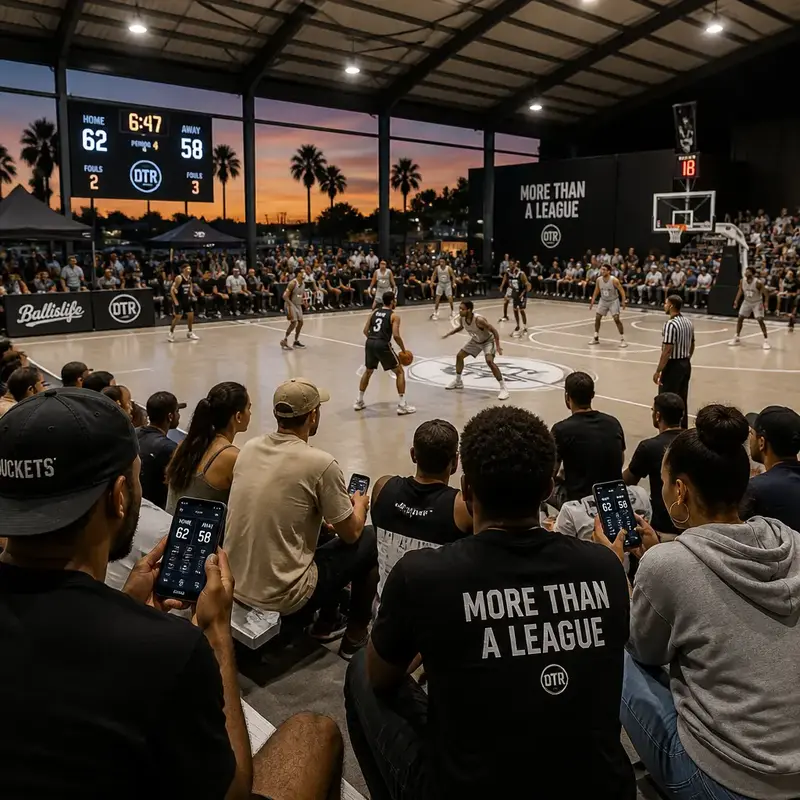
Every action logged in the scoring interface pushes an update to the league's fan-facing page instantly. Fans watching from home or following between courts see the current score, quarter, and key stats without refreshing. The system handles the data distribution automatically.
FIBA PDF Box Score Import
For leagues that already use paper-based FIBA scoresheets, BBStats supports importing those records directly. This means leagues transitioning from manual processes do not lose their historical data, and officials who prefer paper during the game can still feed results into the digital system without double entry.
Playoff Bracket Management
Playoff brackets in BBStats update automatically as results come in. When a game ends, the bracket reflects the outcome immediately. Administrators do not need to log in to a separate tool or send updated bracket images to a group chat.
White-Label Branding and Custom Domains
Each league on the BBStats platform can operate under its own visual identity. Custom branding means a league's scoring page looks like the league's own product, not a generic third-party service. Optional custom domains extend this further, so a league can present its live scores under its own web address, which matters significantly for sponsor visibility and long-term brand building.
OBS Overlay Integration
For leagues that stream games, BBStats provides live streaming overlays compatible with OBS. The scorebug pulls data directly from the live scoring feed, so the stream automatically reflects every basket and quarter change without the streamer needing to manually update any graphics.
What distinguishes BBStats from general-purpose competitors like SportNinja, LeagueRepublic, or TeamLinkt is the platform's sharp focus on basketball-specific operations. General league management tools are often built to handle multiple sports and default to feature sets that work adequately for all of them. BBStats is built around basketball's specific data structure: quarters, shot types, individual foul counts, shot clock management, and FIBA-standard documentation. That specificity shows up in the scoring interface speed and the accuracy of the statistical output.
OBS Overlays and Live Streaming: The Broadcast Layer
The live streaming dimension of NBA-style scoring deserves its own discussion because it represents a significant evolution in what amateur leagues can offer. A league that streams its games on a platform like YouTube or Facebook, with a professional-looking scorebug overlaid on the video, has fundamentally changed its relationship with fans and sponsors.
What an OBS Overlay Actually Does
OBS (Open Broadcaster Software) is the standard free tool for streaming or recording video content. It allows users to add browser-based sources as overlays on top of a camera feed. A basketball live scoring platform that provides a browser-compatible score overlay URL can be plugged directly into OBS as a browser source. The overlay then displays the live score, team names, quarter, and clock, all updating in real time from the same scoring feed the scorer is using at the table.
The result is a stream that looks like a low-budget television broadcast, not a phone recording of a gym. For local leagues, this is a practical and achievable standard, not an aspirational one.
Setting Up the Stream Without a Technical Team
In practice, a two-person setup handles most amateur league broadcasts effectively: one person operates the camera and manages the stream from a laptop running OBS, and one person manages the live scoring at the scorer's table. The scoring data flows automatically to the OBS overlay without any additional coordination between the two. The scorer scores the game. The stream reflects it. That is the entire workflow.
A common mistake is treating the live stream as a separate production from the scoring operation. When both functions draw from the same data source, that separation disappears and the operational complexity stays manageable for a volunteer-run league.
Frequently Asked Questions
What exactly makes a scoring system "NBA-style" versus a basic digital scoreboard?
An NBA-style system captures individual player statistics in real time, not just the team score and clock. It tracks who scored each basket, the shot type, fouls per player, assists, rebounds, and timeouts, all logged during the game and available as a full box score at the end. A basic digital scoreboard shows only the aggregate score and clock, with no player-level data and no automatic connection to standings or historical records.
Does a small local league with no budget really need live scoring?
The cost question is legitimate, but it is worth calculating what manual administration actually costs in time. If three volunteers each spend two hours per game week on score entry, standings updates, and result communication, that is six hours of labor per game week. Across a twenty-game season, that is over a hundred hours of volunteer time that a live scoring platform would eliminate or dramatically reduce. Most dedicated platforms cost a fraction of that labor time when valued even at minimum wage. The question is not really about budget. It is about what the league's volunteers' time is actually worth.
Can one person manage live scoring alone during a fast-paced game?
Yes, provided the scoring interface is well-designed. Platforms built specifically for basketball have fast-access buttons for the most frequent events: two-point baskets, three-pointers, free throws, personal fouls, and timeouts. A trained scorer can log these events in one or two taps while the action continues. The scorer does not need to log every defensive rebound or minor detail in real time. The critical data points are points scored (attributed to a player), fouls, and timeouts. Everything else can be supplemented from the paper scoresheet after the game.
How does FIBA box score import work and who benefits from it?
FIBA-standard paper scoresheets are still required documentation in many organized basketball competitions. A platform that accepts FIBA PDF imports lets an official complete the paper scoresheet during the game as usual, then upload the resulting document to the platform after the game. The platform reads the structured data from the PDF and populates the game record, player stats, and box score automatically. This benefits leagues that are transitioning from fully manual operations to digital platforms without forcing scorers to abandon familiar workflows immediately.
What is the difference between BBStats and a general sports league management platform?
General platforms like TeamLinkt, LeagueRepublic, or SportNinja are designed to handle multiple sports, which means their feature sets are generalized. They manage schedules, registrations, and basic standings well across football, soccer, hockey, and basketball alike. BBStats is purpose-built for basketball, which means its scoring interface is designed around basketball's specific event types, its statistical output matches FIBA documentation standards, and its OBS overlay is built for basketball broadcast graphics. For a league running exclusively basketball, the basketball-specific depth of a dedicated platform produces more accurate records and a faster scoring experience than a multi-sport tool adapted to cover basketball.
Do players actually use league stats pages, or is this feature for administrators only?
Player engagement with statistics pages is consistently one of the highest-traffic behaviors on amateur sports platforms. Players check their personal stats after games, compare their scoring averages against teammates, and track their foul counts through the season. This behavior is strongest among adult recreational and competitive leagues where participants are invested in personal performance data. Providing a public-facing stats page is not a vanity feature. It is one of the most direct levers available to a league administrator for increasing player engagement and renewal rates.
Have you already implemented live scoring in your league, or are you still weighing the transition? Share what has worked for you (or what has not) in the comments, and help other league administrators learn from your experience.
References
- Free basketball scoreboard tool with OBS overlay and NBA-style template options for amateur and rec leagues
- Basketball scoreboard templates for FIBA, NBA-style, 3x3, and streaming setups
- Basketball league management automation guide covering standings, stats, and bracket updates
- Professional real-time scoreboard and OBS overlay platform for amateur sports leagues