
Most amateur basketball leagues still track games with a clipboard, a printed scoresheet, and someone's best guess at halftime stats. Meanwhile, fans are checking their phones for live updates that don't exist, players are arguing over point totals no one can verify, and league organizers are manually compiling season statistics in spreadsheets that are outdated before they're even published. NBA-style play-by-play basketball tracking is no longer reserved for professional franchises with dedicated analytics staff. The tools exist today to bring real-time, possession-by-possession data to any amateur or semi-pro basketball championship, and the gap between what the pros do and what your league does is much smaller than you think.
Table of Contents
- Quick Takeaways
- What Is Play-by-Play Basketball Tracking?
- Why Amateur Leagues Need This Now
- The Building Blocks of an NBA-Style Scoring System
- Comparing Approaches to Amateur Basketball Scoring
- Streaming Overlays and the Broadcast Experience
- How to Run Play-by-Play Scoring with a Small Team
- Frequently Asked Questions
- References
Quick Takeaways
| Key Insight | Explanation |
|---|---|
| Play-by-play tracking goes beyond box scores | A box score tells you what happened. Play-by-play tells you when, in what sequence, and in what context, enabling possession-level analysis unavailable from final stats alone. |
| One dedicated scorekeeper is enough to start | You do not need a stats crew. A single courtside operator with a tablet running the right platform can log every shot, foul, timeout, and substitution in real time. |
| Public live scoring changes fan behavior | When fans can follow games in real time from their phones, they check the league site repeatedly, share links, and return for the next game. Engagement compounds over a season. |
| OBS overlays turn a phone stream into a broadcast | Streaming overlays that pull live game data directly into OBS or Streamlabs make even a single-camera stream look professional, without a production crew. |
| FIBA-compatible PDF export removes a major admin burden | When your scoring platform can export game sheets in FIBA-standard PDF format, you eliminate the manual paperwork step that trips up most league administrators after every game. |
| Automated playoff brackets depend on accurate live data | If your regular-season stats are tracked in real time, bracket seeding becomes automatic. Manual stat entry is the main reason brackets get delayed or disputed. |
| Amateur basketball scoring apps vary sharply in basketball specificity | Generic sports management tools handle scheduling and registration but often lack basketball-specific stat categories and true play-by-play event logging. Choose a basketball-first platform. |
What Is Play-by-Play Basketball Tracking?
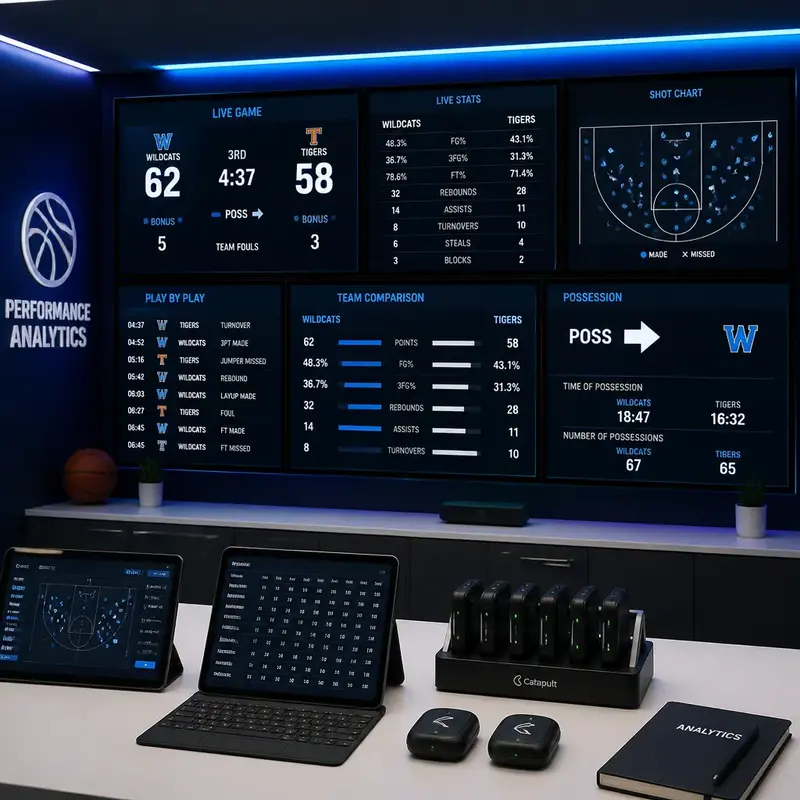
Play-by-play data records every single event that occurs in a basketball game, not just the totals at the end. Every made field goal, missed free throw, offensive rebound, personal foul, timeout, substitution, and turnover is logged with a timestamp and attributed to a specific player and team. The result is a chronological transcript of the entire game, not just a summary.
At the NBA level, this data infrastructure is enormous. Second Spectrum is the current Official Optical Tracking Provider of the NBA and began league-wide tracking in the 2017-18 NBA season. The NBA uses an optical tracking system that places multiple cameras in the catwalks of all 30 NBA arenas, with cameras receiving and updating data at a rate of 25 frames per second. That is not what your semi-pro league needs, nor what you can realistically afford. But the underlying concept, logging events as they happen and attributing them correctly, translates directly to a tablet-based scorekeeper at a community gym.
Play-by-play data records every single play that occurs in every basketball game, and the NBA has been tracking play-by-play data since the 1996-1997 season. The difference today is that the software infrastructure to do this at an amateur level now exists, is affordable, and requires no specialized hardware beyond a smartphone or tablet.
Box scores are the quickest and easiest way to gain an understanding of the game action, covering points, rebounds, assists, and slightly more advanced stats like plus-minus from both an individual and a team perspective. But what the box score cannot tell you is the sequence, the momentum shifts, which lineup was on the floor during a 12-2 run, or when a specific player's foul trouble became a turning point. That is the practical value of play-by-play for any league, amateur or professional.
Comparing Approaches to Amateur Basketball Scoring
League organizers evaluating their options for amateur basketball league scoring typically encounter three broad approaches. The differences between them are not subtle. Choosing the wrong one means either paying for features you cannot use or, more commonly, underbuilding and reverting to spreadsheets six weeks into the season.
| Approach | What It Delivers | Key Limitation for Basketball Leagues |
|---|---|---|
| Generic League Management Platforms (e.g., LeagueApps, TeamLinkt) | Registration, scheduling, payment collection, basic score entry. Good for multi-sport organizations managing logistics. | Stat tracking is typically limited to final scores or simple box score totals. No true play-by-play event log, no streaming overlay, no basketball-specific possession tracking. You will still need a separate stats solution. |
| General Live Scoreboard Tools (e.g., KeepTheScore) | Real-time score display, OBS overlay integration, shareable scoreboard links. Useful for livestreaming the current score. | Designed for score display, not statistical depth. No player-level stat tracking, no season aggregation, no play-by-play event history. Fans see the score but no meaningful data beyond it. |
| Basketball-First Statistics Platforms (e.g., bbstats.am) | Full play-by-play event logging, player stat tracking across a season, automated playoff brackets, OBS streaming overlays, FIBA PDF export, public fan pages, custom branding and domain support. | Requires a dedicated scorekeeper and upfront roster setup. More configuration than a simple scoreboard tool, but that configuration is what enables everything else to work automatically. |
The practical difference between a generic platform and a basketball-first one becomes visible the first time you need to seed a playoff bracket using regular-season statistics, or the first time a player disputes their foul count from a game three weeks ago. Generic tools cannot resolve either problem from their own data. A basketball-specific play-by-play system can resolve both in seconds.
A box score tells you who won. A play-by-play tells you why, and when the game actually turned. That second layer of information is what separates a league that players talk about from one they just show up to.
Streaming Overlays and the Broadcast Experience
The most visible way to signal that your league takes its presentation seriously is a live stream with a professional-looking scorebug. A scorebug is the small overlay in the corner of a broadcast showing the score, game clock, period, and team names. Every NBA and college basketball broadcast has one. Producing one for an amateur league used to require dedicated broadcast hardware. It no longer does.
Modern basketball scoring platforms output a transparent browser-based overlay URL that you add to OBS or Streamlabs as a browser source. A scoreboard exposes a transparent overlay URL that you drop into OBS or Streamlabs as a browser source, working for league streams, high-school broadcasts, and pickup-game streams alongside your camera feed. When your scoring platform is connected to your play-by-play tracker, the overlay updates automatically with every scored basket, every foul logged, and every timeout called. The streamer running the camera never has to touch the graphic manually.
The production quality this creates is disproportionate to the effort required. A league streaming a game on a single phone camera with a proper scorebug overlay and real-time stats looks more legitimate than a multi-camera stream with no data. Fans sharing the stream link on social media are effectively promoting the league every time a game is live.
Pro tip: When setting up OBS overlays for basketball streams, position the scorebug at the top of the frame rather than the bottom if your camera angle is low. A low camera angle with a bottom scorebug will frequently be obscured by players moving along the baseline. Test your overlay placement in a practice recording before the first live game of the season.
How to Run Play-by-Play Scoring with a Small Team
Setting Up Before the Season Starts
The biggest mistake league organizers make is treating the scoring platform as something to configure on game day. Pre-season setup is what makes game-day operation smooth. Before the first game, every team roster must be loaded with player names and jersey numbers. Every game on the schedule must be entered with the correct teams, venue, and tip-off time. The platform should know the full season structure before anyone touches a tablet courtside.
For leagues using FIBA-format scoresheets, confirm that your platform can export game data in FIBA PDF format before the season starts, not mid-season when an external federation or governing body first asks for documentation. Discovering a format incompatibility during a playoff run is a genuine operational crisis that is entirely avoidable.
Training Your Scorekeepers
A single training session of 30 to 45 minutes is sufficient for a scorekeeper to become confident with a well-designed play-by-play interface. Run a scrimmage game or use a recording of a past game and log events against it in real time to build muscle memory. Focus on the most frequent events first: made baskets, fouls, and substitutions. Rarer events like technical fouls or shot clock violations can be addressed once the core workflow is natural.
Scorekeeper turnover is a real risk for amateur leagues. Document your scoring workflow in a one-page reference sheet that a new scorekeeper can use without prior training. A platform with a clean, self-explanatory interface reduces this dependency significantly.
Using Stats to Run a Better League
Once you have a season of play-by-play data, the administrative possibilities expand substantially. Analyzing the impact of different five-man lineups on shooting percentage, seeing which lineups are associated with better or worse shooting, and looking at the frequency of assists between different player pairings are analyses that coaches at every level find immediately useful. Offering this data to team coaches as part of the league package increases the perceived value of league membership and gives coaches a concrete reason to recommend your league to their players.
Playoff seeding disputes are one of the most common sources of conflict in amateur league administration. When every game's play-by-play data is logged in a single system, standings are updated automatically and any dispute can be resolved by reviewing the event log for any specific game. There is no ambiguity when the data is complete and timestamped.
Frequently Asked Questions
What does NBA-style play-by-play tracking actually include at the amateur level?
At the amateur level, NBA-style play-by-play tracking means logging every scored basket, missed shot, rebound, assist, turnover, foul, substitution, and timeout with a game-clock timestamp attributed to a specific player. It does not require camera-based player tracking or motion sensors. A single scorekeeper with a tablet running a dedicated basketball scoring platform can produce a complete play-by-play log for any game.
How many people do you need to run play-by-play scoring for an amateur game?
One dedicated scorekeeper is sufficient for a standard amateur basketball game. That person needs a tablet or smartphone, a stable internet connection, and familiarity with the scoring platform. Some leagues use two scorekeepers for playoff games, one logging events and one cross-checking the official paper scoresheet, but this is not required for regular-season games.
Can a small league afford a proper basketball statistics platform?
Yes. Basketball-specific league management and statistics platforms are typically priced for organizations of all sizes, including single-division community leagues. The more relevant question is the cost of not having one: hours of manual stat compilation each week, disputes you cannot resolve, fan engagement you cannot offer, and playoff brackets you cannot automate. The administrative time saved typically justifies the platform cost within the first month of a season.
What is the difference between a live scoreboard and a play-by-play tracker?
A live scoreboard shows the current score and game clock, updating in real time. A play-by-play tracker logs every individual event that produced that score, with attribution and timestamps. You can use a live scoreboard without any play-by-play tracking, but you cannot produce meaningful player statistics, lineup analysis, or game recaps from a scoreboard alone. For a professional-quality league experience, you need both, and the best platforms deliver both from a single data entry point.
How does play-by-play data connect to playoff bracket management?
Playoff brackets are seeded based on regular-season standings, which are calculated from game results and, in tiebreaker situations, from head-to-head records or point differentials. When all regular-season games are logged in a play-by-play system, all of this data is already in the platform. Bracket generation becomes an automatic output rather than a manual calculation. Leagues that track stats in real time throughout the regular season can publish a finalized, accurate playoff bracket within minutes of the last regular-season game ending.
Is it realistic to stream amateur basketball games with a professional-looking overlay?
Completely realistic. The current generation of basketball scoring platforms outputs a browser-based overlay URL that integrates directly with OBS or Streamlabs. You add the URL as a browser source in your streaming software, and the overlay updates automatically as events are logged by the scorekeeper. The result is a scorebug displaying the live score, game clock, period, and team information, identical in concept to what a television broadcast uses, requiring no broadcast hardware and no graphic design skills.
Do I need special hardware to run play-by-play tracking at a gym?
No specialized hardware is required. A smartphone or tablet with internet access is the only equipment needed for the scorekeeper. The platform runs in a browser or as a mobile app. For the streaming overlay, a laptop running OBS connected to the internet is sufficient. The main practical requirement is a reliable internet connection at the venue, which is worth confirming in advance since some gyms have poor or restricted Wi-Fi. A mobile data connection as a backup is a sensible precaution for important games.
Have you run play-by-play scoring for your league, or are you still weighing the options? Share what has worked or what has held you back, and let's make this resource more useful for every organizer reading it.
References
- Wikipedia overview of basketball scorekeeping history and methods
- Wikipedia article on NBA player tracking technology and Second Spectrum
- NBA play-by-play data explained: what it includes and how it is used for analytics
- Practical analysis of NBA play-by-play data and what it reveals beyond box scores
- How to set up a basketball scoreboard overlay in OBS for live streaming