
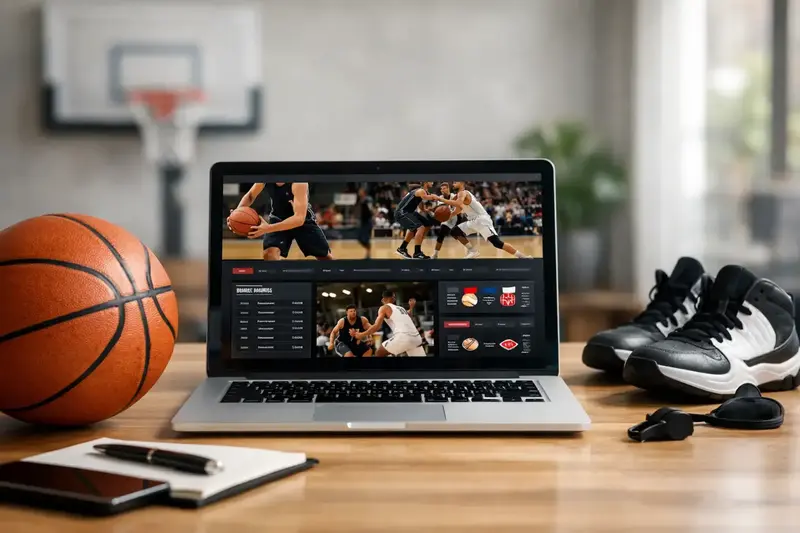
A close game should not end with a scorekeeper texting a final score to an administrator, who updates a spreadsheet, who later edits a website. A basketball league website builder should carry the game from the scorer's table to the public standings while the result still matters to players, parents, sponsors, and fans.
For league operators, the website is not simply a marketing page. It is the public record of the competition: schedules, results, rosters, box scores, standings, playoff paths, and league identity. The right system reduces duplicate work behind the scenes while giving every game a professional digital presentation.
A league website must do more than publish pages
Generic website builders can create an attractive home page, but basketball operations create moving data. Tip-off times change. Rosters change. A team forfeits, a makeup game is added, or a tie-breaking scenario reshapes the standings. During playoffs, one result may advance a team into the next round immediately.
A usable league platform connects those events instead of treating them as separate publishing tasks. When a scorekeeper records a made three-pointer, foul, timeout, or substitution, that action should contribute to the live score, play-by-play, player totals, team totals, and eventual box score. Once the game is final and reviewed, standings and playoff brackets should reflect the result without another round of manual entry.
That distinction matters most to organizations that have outgrown spreadsheets and static site updates. A recreational league may begin with a simple schedule page. A multi-division youth program, regional adult league, or semi-professional competition quickly needs a reliable source of truth for official results and public communication.
What to look for in a basketball league website builder
The strongest choice is built around the full game-to-fan workflow. Start by asking how information enters the system, how it is checked, and where it appears once it is official.
Live scoring that creates usable data
Live scoring is more than a changing number at the top of a page. Scorekeepers need an interface that reflects real basketball operations, including an NBA-style game clock, period management, team fouls, player fouls, timeouts, substitutions, and play-level events.
Each recorded event should feed player and team statistics automatically. That eliminates the common problem of a final score being correct while individual points, rebounds, assists, and shooting totals are missing or inconsistent. A detailed event log also gives operators a practical way to review a disputed statistic after the game.
For fans, real-time delivery matters. WebSocket event delivery can update the scoreboard, game center, and play-by-play as actions are recorded, rather than requiring a page refresh. The trade-off is operational discipline: scorekeepers need training, a stable device, and a clear process for correcting entries. A quality platform makes corrections visible in the recalculated totals instead of forcing administrators to patch numbers in multiple places.
Schedules, standings, and competition rules that stay connected
A basketball season rarely follows a perfectly fixed calendar. Gyms become unavailable, weather interrupts travel, and teams may need a rescheduled game. Your league website should let administrators adjust fixtures without rebuilding the public schedule by hand.
Standings should calculate from the rules your competition actually uses. That can include wins and losses, points percentage, points for and against, head-to-head results, division records, and other configured tie-breakers. Before launching, test those rules with real edge cases. A standings table is only credible when league staff can explain why two tied teams appear in a particular order.
Playoffs require the same attention. Look for bracket tools that support the format you run, whether that is single elimination, a seeded tournament, or a best-of-3 series. When a series ends, the winner should advance automatically and the next matchup should publish to the bracket without a separate graphics update.
Official-stat imports for leagues with established scorekeeping
Not every organization will score every game directly in one platform. School, federation, and tournament environments may receive official FIBA or Genius Sports PDF box scores after games. In that workflow, import capability is not a minor convenience. It determines whether results can be published quickly without retyping every player line.
Evaluate how imported data is reconciled with teams, rosters, and scheduled games. The system should help administrators confirm that the correct player and matchup are being matched before statistics become public. A fast import is valuable, but a fast import with weak validation can create permanent errors in season leaders and player histories.
Build for fans, operators, and broadcast crews
A league website has several audiences, and each needs different information at different moments. Operators need control. Coaches and players need accurate schedules, rosters, and statistics. Fans need a clear place to find tonight's game, follow live action, and understand the playoff picture.
The public site should make the essential information easy to reach on mobile: current games, upcoming fixtures, recent results, standings, team pages, player pages, and game recaps or box scores. Consistent colors, logos, typography, and navigation give an independent league the credibility of a larger competition without creating a design project for every update.
For media teams, consider how the platform connects to live production. A streaming-ready OBS browser-source overlay can display live scores, clocks, team names, and player information in a broadcast scene. Because the overlay reads the same live game data as the website, the production team is less likely to show a score that disagrees with the official game center.
Notifications also belong in the operating model. Push and email alerts can tell supporters about game starts, final scores, schedule changes, or playoff advancement. Use them selectively. A parent may appreciate a venue change notice immediately, while repeated promotional messages can lead to unsubscribes. Segmenting communications by league, team, or audience interest is more useful than sending every update to everyone.
Keep the league brand without adding technical overhead
A professional website should look like the league, not the software behind it. That means configurable branding, a league-specific public site, and the option to connect a custom domain when the organization is ready. A free subdomain can be enough for a new league; an established organization may need its own domain for sponsor materials, search visibility, and a consistent identity across social and broadcast channels.
Technical basics deserve attention because they affect trust. Automatic HTTPS protects public traffic, while tenant isolation keeps one league's administration and data separate from another's. Ask how backups are retained, who can access administrative controls, and whether roles can be assigned for commissioners, scorekeepers, team staff, and media personnel.
A multi-tenant platform such as bbstats.am can provide each competition with its own branded environment without requiring the league to maintain servers, deploy updates, or coordinate separate tools for scoring and publishing. That is especially practical for operators managing several divisions or recurring tournaments under one organization.
Test the workflow before committing
A product demonstration should answer more than whether the home page looks polished. Ask to run a sample game from opening tip to final result. Enter a few scoring plays, a substitution, a foul, and a correction. Confirm that the live game view, box score, player statistics, standings, and bracket respond as expected.
Also test the less glamorous scenarios: a postponed fixture, an incorrect roster assignment, a score correction after a game, and an imported official PDF. If your league streams games, open the browser-source overlay in OBS and verify that it updates at the pace your production crew needs. Shared demo access and resettable demo data are useful because staff can practice without worrying about damaging a live season.
The best choice depends on the league's maturity. A short weekend tournament may prioritize quick setup, bracket visibility, and results publishing. A full-season league may put more weight on detailed stats, roster history, multi-division standings, notifications, and custom branding. In either case, avoid paying for a website that only displays information your staff must assemble elsewhere.
Choose a system that makes the official game record easier to produce and easier to trust. When the final buzzer sounds, your league should be ready to publish the result, advance the competition, and give fans a reason to stay connected for the next game.