
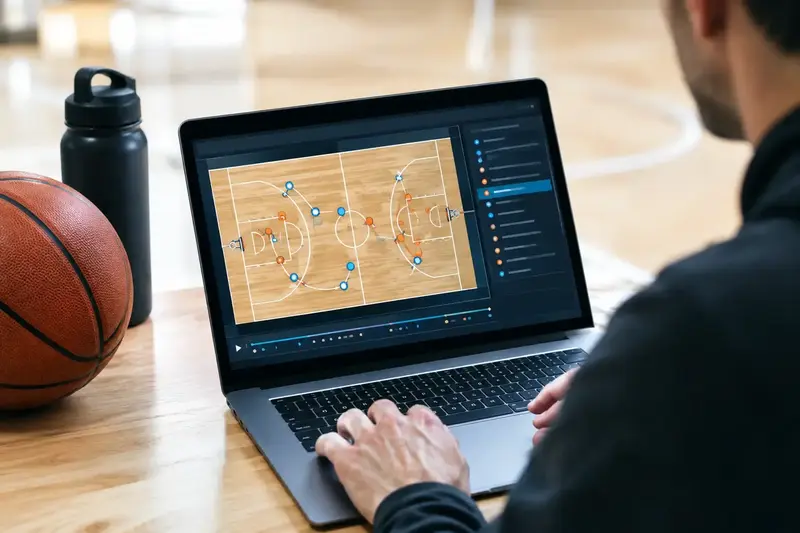
A one-point game with 40 seconds left is not decided by the final score alone. League staff, coaches, and fans want to know what happened in the possessions that created it: the missed shot, the offensive rebound, the turnover, the foul, and the final stop. Basketball possession tracking software turns those events into a usable record while the game is still being played.
For an independent league, that matters well beyond advanced analytics. Possession-level scoring creates cleaner box scores, more credible standings, better postgame reporting, and a public game log that supporters can follow from their phones. The practical question is not whether every league needs professional-video tagging. It is whether the scoring workflow captures enough structured information to make each result trustworthy and useful.
What possession tracking actually records
A possession is the stretch of play in which one team controls the ball, ending with a made basket, a defensive rebound, a turnover, or a sequence of free throws that gives the other team control. Tracking software does not need to ask a scorekeeper to press a separate button labeled “possession” after every play. In a well-designed workflow, the system derives possession changes from the events the scorekeeper already records.
A made two-pointer updates the score and closes the offensive team's possession. A defensive rebound confirms that the missed shot did not result in a second chance. A steal, offensive foul, shot-clock violation, or out-of-bounds turnover changes control immediately. These details are the building blocks for possession estimates, pace, offensive efficiency, turnover rate, and second-chance opportunities.
The distinction matters because a final score can hide the quality of a game. A 78-72 result may have been a slow, defensive contest or a high-tempo game with poor shooting. Once scoring events are structured correctly, operators can explain that difference without asking volunteers to build formulas in a spreadsheet after the gym is empty.
Live scoring is the source of truth
The most reliable possession data starts at the scorer's table. If events are entered after the game from memory, possession timing, player attribution, and team-control changes become harder to reconcile. A live scorekeeping interface should let an operator record shots, rebounds, assists, steals, blocks, fouls, substitutions, timeouts, and turnovers against the active lineup and game clock.
That does not mean every event must be captured at the same depth. A youth recreational league may prioritize score, fouls, and basic player statistics. A regional competitive league may require turnover types, offensive versus defensive rebounds, and live play-by-play. The right level depends on the competition, the training available to scorekeepers, and the time available between games.
The critical requirement is consistency. Capturing a smaller, well-defined set of events every night is more valuable than aiming for NBA-level detail that volunteers cannot enter accurately under pressure.
Why basketball possession tracking software improves league operations
Possession data is often discussed as a coaching tool, but league operators see the first gains in administration. When a scorekeeper records a possession-ending event, the same entry can update the live score, player stat line, team totals, public play-by-play, and game status. That reduces duplicate entry and gives staff fewer records to compare later.
For a commissioner, reconciled data is the operational benefit. Team points should match scoring plays. Player rebounds should roll into team rebound totals. Period scores should match the final score. A platform should flag mismatches before a game is published as final, rather than leaving staff to discover them after standings and social posts have already gone out.
Possession-aware records also make disputes easier to resolve. When a coach asks why a player has been credited with three turnovers instead of two, staff can review the timestamped play-by-play rather than rely on a paper sheet or recollection. The same event history helps correct an accidental score entry without losing the rest of the game's statistical context.
For fans, the immediate benefit is context. A live page that shows the current score, period, clock, recent events, and individual leaders feels like an official competition product. When WebSocket event delivery publishes updates as the scorekeeper enters them, supporters do not need to wait for someone to refresh a spreadsheet or manually post a result.
Better metrics, with sensible limits
Once events are complete, possession estimates support useful team measures. Pace shows how many possessions a game contains. Offensive rating measures points per 100 possessions. Turnover percentage, offensive rebound percentage, and free-throw rate help separate shooting performance from ball security and extra chances.
These metrics should be presented with appropriate caution. A single game can produce misleading results, especially in short-format tournaments, youth games with uneven opponents, or leagues that use unusual rules. A team that plays one 36-minute game should not be evaluated as if it has a full season of comparable possessions.
Leagues should also define how their rules affect reporting. Technical free throws, alternating-possession rules, overtime periods, and running-clock regulations can change the interpretation of pace and possession counts. The software should accommodate the competition's actual game settings instead of forcing every event into a generic template.
Build the workflow around the scorer's table
The technology is only as effective as the people entering the game. Before opening night, establish one scoring standard and use it across every venue. Decide who is responsible for live entry, who verifies the final box score, and who has authority to make postgame corrections.
A practical setup starts with a tablet or laptop at the table, a reliable connection where available, and a scorer who can see the court and official clock. The interface should display active players, team fouls, timeouts, period status, and a real-time preview of the public game page. That reduces the chance that an operator records a basket for a player who has been substituted out or applies a foul to the wrong team.
Training should focus on common sequences rather than a long feature tour. Run through a missed field goal followed by an offensive rebound, a shooting foul with multiple free throws, a steal leading to a fast-break score, and an end-of-period correction. These are the moments when possession logic and scoreboard totals are most likely to separate if the workflow is unclear.
After the final horn, a designated reviewer should compare the on-screen totals with the official scorebook before confirming the game. If your league receives official FIBA or GENIUS PDF box scores, imports can provide a valuable reconciliation path. They are particularly useful when an event has an established official-stat process or when historical games need to be added without recreating each play manually.
Connect possession data to the public league experience
Possession tracking becomes more valuable when it is not trapped inside an administrator dashboard. A branded league site can publish schedules, standings, team pages, player profiles, game centers, and playoff brackets from the same dataset used at the scorer's table. There is no need to copy a final score from one tool into a website, then re-enter it for a social update or broadcast graphic.
For playoff competitions, that connection is especially useful. A final game status can advance the winning team through a single-elimination bracket or update a best-of-3 series automatically. Operators still need control over eligibility and bracket seeding, but the routine movement of results should not require a late-night manual edit.
Sports-media staff can also use the live event feed for production. A browser-source overlay in OBS can display the score, clock, fouls, and leading players during a stream. This does not replace a full broadcast crew, and a weak venue connection still requires a contingency plan. It does give local leagues a credible way to pair live stats with video without maintaining a separate graphics system.
A platform such as bbstats.am is designed around this connected model: scorekeeping, statistics, schedules, brackets, league branding, public publishing, and supporter notifications operate from the same league record. Each league can maintain its own tenant and visual identity, including a custom domain when required, while keeping operational access separate from public-facing pages.
Choose the level of detail your league can sustain
When evaluating basketball possession tracking software, avoid treating the longest feature list as the automatic winner. Ask whether the system supports your scoring rules, whether a new scorekeeper can learn it before the first tip, and whether the resulting data reaches the people who need it. A detailed event model is valuable only if it produces accurate records consistently.
Also consider exception handling. Can staff correct a misattributed basket after it is entered? Can a completed game be reviewed without changing a published result accidentally? Are schedules, rosters, standings, and playoff rules tied to the same administrative environment? Can the league retain an audit-friendly event record if a result is questioned?
The best implementation often begins with a pilot. Run a preseason game or a small tournament, let table staff enter real sequences, verify the box score, test the fan-facing game page, and confirm that any stream overlay receives updates as expected. Fix the workflow before the data carries standings implications.
A possession record should make a busy game easier to operate, not create another job after the final buzzer. Start with accurate live events, give scorekeepers a clear review process, and let every confirmed play support the official record your league is building.