
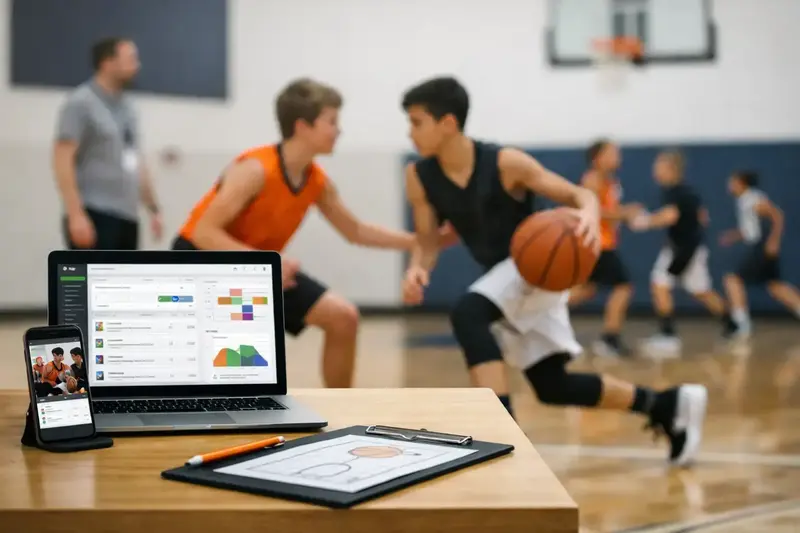
A basketball league can survive a late score correction. It should not have to survive a workflow where the scorekeeper uses one app, the commissioner updates standings in a spreadsheet, the website editor posts results hours later, and the broadcast crew rebuilds graphics for every game. A LeagueApps alternative for basketball should reduce those handoffs, not simply move registration into a different dashboard.
LeagueApps can be a sensible choice for organizations centered on registration, payments, participant communications, and broad multi-sport program management. Basketball operators, however, often need a different operational center of gravity. Once games begin, the work is about possession-level scoring, verified box scores, standings logic, playoff advancement, public statistics, and a credible fan experience.
When a LeagueApps Alternative for Basketball Makes Sense
The question is not whether one platform is universally better. It is whether the platform matches the part of the operation that creates the most work and the most public visibility.
For a youth program that runs camps, clinics, and several sports, registration administration may be the primary requirement. A general sports-management system can fit that model well. For a basketball league running weekly fixtures, regional tournaments, or a semi-professional season, the pressure usually shifts to game operations. Fans expect results as games happen. Coaches expect player totals to reconcile with the official book. Commissioners need standings to reflect tie-breakers and forfeits without manual repair.
That is where a basketball-specific platform earns its place. It treats the game record, rather than the registration form, as the central source of truth. Team rosters feed the scorekeeping interface. Scoring events create play-by-play, box scores, and player statistics. Finalized games update standings and bracket positions. The public league site reflects the same data operators see in the back office.
Evaluate the Live Game Workflow First
A platform can have attractive registration pages and still create problems on game night. Before selecting a LeagueApps alternative for basketball, ask what happens from the opening tip through publication of the final result.
Scorekeeping must produce usable league data
Basketball scoring is not just recording a final score. A usable system should capture field goals, three-pointers, free throws, rebounds, assists, steals, blocks, turnovers, fouls, timeouts, and substitutions in a way that produces a coherent box score. The game clock needs basketball-specific controls, including period settings, overtime, possession context where applicable, and NBA-style timing behavior.
The scorekeeper also needs a practical correction path. Mistakes happen: a rebound is assigned to the wrong player, a three is initially logged as a two, or a foul must be moved after the table reviews the sequence. Operators should be able to reconcile the record before finalizing it, without making fans wonder which version of the score is official.
For leagues that receive official statistics from venues or federations, PDF import matters. Support for FIBA or GENIUS box-score PDFs can prevent staff from re-entering a complete game by hand. The imported record should map to teams, players, totals, and game results in the same league database used for standings and public pages.
Real-time updates should reach more than one screen
A live score is more useful when it propagates automatically. As scoring events are entered, the league website, game center, standings view, and available broadcast overlay should update from the same event stream. WebSocket delivery is particularly useful here because it pushes new events to connected viewers immediately rather than depending on visitors to refresh a page.
This is operationally different from posting a final result after the game. Real-time play-by-play gives remote parents, supporters, media staff, and opponents a current view of the contest. It also creates a usable production feed for streams. An OBS browser-source overlay can display the current score, clock, team identity, and player statistics without requiring a producer to type every update separately.
The trade-off is staffing. Live data is only as accurate as the person operating the scorer’s console. For a casual recreational division, a simplified scoring workflow may be appropriate. For competitive divisions, assign trained scorekeepers and define a final-review process before statistics become official.
Keep Standings and Playoffs Connected to Results
Manual standings are one of the most common points of failure in independent basketball leagues. A score is entered correctly, but the win percentage formula is wrong. A forfeiture does not apply the intended points. A tie-breaker is calculated inconsistently. The public table then disagrees with the commissioner’s internal spreadsheet.
A basketball-first system should calculate standings directly from completed games and allow the league to configure the rules it uses. That includes points for wins and losses, forfeits, head-to-head logic, point differential limits when relevant, and division-level schedules. Administrators should still be able to correct exceptional cases, but exceptions should be visible and controlled rather than buried in a private workbook.
Playoffs require the same level of connection. If a quarterfinal ends, the bracket should advance the winner automatically. If the league runs a best-of-3 semifinal, the series view should show each game, the current series score, and the next required fixture. A bracket that must be manually redrawn after every result is not a playoff tool. It is a graphic waiting to become outdated.
This matters most during compressed events. A weekend tournament may have several courts finishing within minutes of one another. Automatic advancement gives teams, officials, and fans a current picture of who plays next without waiting for a staff member to update a separate page.
Give the League a Public Home, Not Just an Admin Portal
Players and administrators will tolerate a functional back office. Fans judge the league through what they can see: schedules, standings, game results, team pages, player leaders, playoff brackets, and live game status.
A capable platform should publish those elements on a branded, mobile-friendly league site. Every league should have its own tenant, isolated from other organizations, with a free subdomain available at launch and optional custom-domain support when the organization is ready. Automatic HTTPS is not a cosmetic extra. It protects visitor traffic and avoids the browser warnings that undermine confidence in a league’s official site.
Brand controls should cover logos, colors, navigation, and league identity without turning each setup into a custom development project. A local adult league may need a clean public schedule and stat leaders. A regional competition may also need division hubs, sponsor-ready pages, detailed player profiles, and media-facing results. The right system gives both organizations a professional publishing layer while keeping league data centralized.
Notifications complete the public workflow. Push and email updates can inform followers when a game starts, a result is finalized, or a schedule changes. These are most effective when they are triggered by actual league events, not manually assembled after staff have already finished a long game night.
Questions to Ask During a Platform Review
A product demonstration should follow a real basketball workflow rather than a generic feature tour. Ask the provider to create teams and rosters, score a live sample game, correct an event, finalize the box score, show the updated standings, and advance a playoff series. Then ask to see the same game on the public site and in a streaming overlay.
Also ask how the platform handles data ownership, tenant separation, backups, and retention. League history has long-term value. Records, player statistics, championship brackets, and old box scores become part of the organization’s archive. A practical vendor should be able to explain backup practices and what happens to league data if an administrator changes or a season ends.
Finally, look at implementation effort. A feature set is only useful if a commissioner can configure it before the season. Import options, roster tools, reusable season structures, guided setup, and resettable demo data help operators verify the workflow before committing to production use.
Where bbstats.am Fits
bbstats.am is designed for leagues that want live scorekeeping, real-time play-by-play, public statistics, schedules, standings, brackets, notifications, and streaming-ready overlays in one branded basketball system. It is a stronger fit when the league’s public game experience and official statistical record matter as much as its administrative setup.
It will not replace every specialized tool for every organization. A large multi-sport organization with advanced fundraising, complex membership programs, or extensive camp registration may still retain dedicated tools for those functions. But basketball competition data should not need to travel through disconnected systems before it reaches the standings table, fan website, or broadcast.
The best platform decision starts with a game-night test. Follow one real matchup from roster check through the final horn, the verified box score, the revised standings, and the next playoff pairing. If the information moves once, accurately, and visibly to everyone who needs it, the league has built an operation that can grow without adding more spreadsheets.