
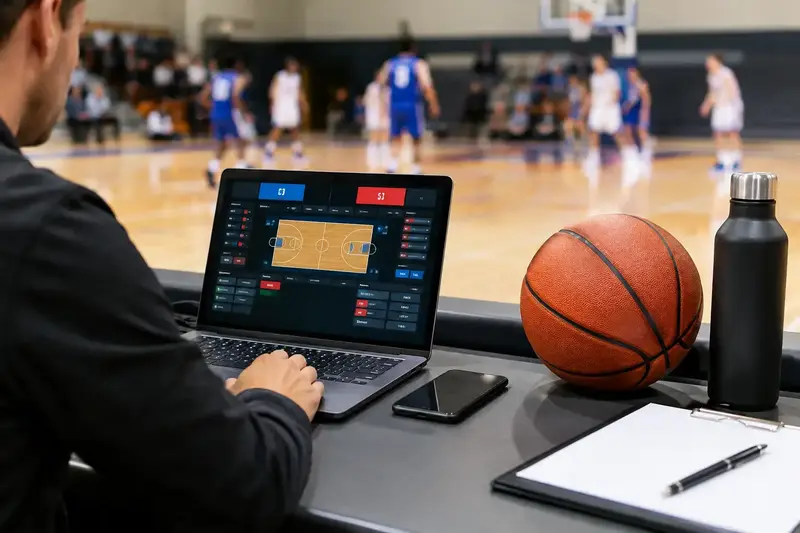
A close game should not end with a scorekeeper reconciling a paper sheet, a commissioner updating a spreadsheet at midnight, and fans refreshing a social feed for a final score. When you set up live basketball scoring correctly, every made basket, foul, timeout, and substitution becomes usable league data as the game happens.
For league operators, that changes more than the presentation of a single game. It creates a reliable path from courtside inputs to a public box score, updated standings, player leaders, playoff implications, notifications, and broadcast graphics. The key is to build the workflow around the people operating it, not around a collection of disconnected tools.
Start with the official game workflow
Live scoring begins before tipoff. Create the game in the schedule with the correct date, venue, teams, competition phase, and game status. Confirm each roster is current, including jersey numbers, active players, coaches, and staff. A scorer should not have to stop in the first quarter to ask whether No. 22 is a new player or a duplicate profile.
Decide which record is official. For many local leagues, the live scorekeeper's game log is the primary record. For events that receive official FIBA or GENIUS PDF box scores after the game, the live record may serve as the public real-time feed while the imported official document becomes the reconciled final record. Both approaches work, but the policy should be clear before the season begins.
Assign responsibility at the table. One trained operator can score a straightforward recreational game, but competitive games often benefit from separate roles: a scorekeeper entering plays, a timekeeper running the clock, and a commissioner or statistician available to resolve exceptions. The practical question is not whether a league can staff every role. It is whether one person can accurately maintain the required level of detail during fast possessions.
Configure clocks before you set up live basketball scoring
A live score without a credible clock quickly loses trust. Configure the period length, halftime, overtime rules, shot-clock behavior if used, team fouls, bonus thresholds, timeouts, and possession indicators to match your rulebook. NBA-style clock displays are useful for a professional fan experience, but only when their settings reflect the competition being played.
Run a short pregame test. Start the game clock, stop it for a foul, add a made field goal, charge a timeout, and advance to the next period in a test fixture or preview environment. Check that the public game view updates as expected and that the scorekeeper understands how to correct an accidental entry.
This is also where leagues should define their correction policy. A missed assist may be corrected at the next dead ball. A scoring error may require review before it appears in final statistics. If a connection drops, the scorekeeper needs to know whether entries are retained locally, queued for delivery, or must be re-entered. A disciplined procedure is more valuable than trying to make every game situation automatic.
Capture plays that produce useful statistics
At minimum, scorekeepers need to record scoring plays, free throws, fouls, timeouts, substitutions, and period changes. For leagues publishing full player statistics, capture rebounds, assists, steals, blocks, turnovers, and relevant shot details as well. The right level of detail depends on the league's operating capacity and its audience.
A youth league with volunteer table staff may prioritize accurate scores, minutes, fouls, and basic points. A semi-professional competition promoting player leaders and game broadcasts may need a complete play-by-play log. Trying to collect advanced data without trained operators can create more errors than value. Start with the statistics your staff can produce consistently, then expand training and data requirements over time.
Every action should update the box score from the same event record. That prevents a familiar problem: the scoreboard says 64-61, the website says 62-61, and the standings administrator has a third number in a spreadsheet. One source of truth lets points, team totals, player lines, and the public game page move together.
Publish live data to the places fans use
Real-time data has value only if it reaches the right audience. A public league website should show the current score, game clock, period, team fouls, roster information, play-by-play, and an updating box score. When an event changes, WebSocket event delivery can refresh those views immediately instead of asking fans to reload a page.
For game-night communications, set notification rules carefully. A final-score push notification is useful for every follower. Alerts for a game start, a close fourth quarter, or a playoff clincher may also be appropriate. Constant notifications for routine score changes can become noise, especially when supporters follow several teams.
Streaming staff need the same reliable game state. An OBS browser-source overlay can read the live score, clock, team names, and branding from the platform rather than relying on someone to manually update a graphic. This reduces production risk, but it requires a clear technical check before the broadcast: verify the overlay source, browser connection, team colors, and fallback plan if venue internet is unstable.
Let completed games advance the league automatically
The final horn should trigger operational work, not begin it. Once an authorized scorekeeper or administrator finalizes the game, standings should recalculate using the league's configured rules. Player and team statistics should update, completed results should appear on the schedule, and playoff scenarios should reflect the new outcome.
For a bracket, automation is especially useful. A best-of-3 series should track individual game results, display the series count, and advance the winning team only when the required number of wins is reached. The commissioner still needs authority to postpone, void, or correct a game, but routine progression should not depend on manually moving logos or entering results in several places.
Use a review step for games with disputed plays, protests, or imported official documents. Mark the game as final only when the league is ready for its result to affect standings and brackets. This protects public credibility and avoids the confusion of changing a playoff matchup after supporters have already seen it published.
Build a repeatable game-night checklist
A repeatable checklist makes live scoring less dependent on one experienced volunteer. Before each game, confirm the following:
- The correct fixture, rosters, jersey numbers, and rules are loaded.
- The scoring device is charged, connected, and signed into the right league workspace.
- The clock settings and public game preview have been tested.
- The scorekeeper, timekeeper, and any backup contact know their responsibilities.
- Streaming overlays and notification settings match the event plan.
After the game, verify the final score against the table record, review unusual player totals, confirm the game status, and publish or import the official box score if required. Keep the checklist short enough that staff will use it under real game-night pressure.
Choose a platform that supports the whole operation
A scoring app alone can record a game, but it may leave operators exporting data, rebuilding standings, maintaining a separate website, and recreating score graphics for broadcasts. A full league platform connects those jobs while keeping each league's data and branding isolated in its own tenant.
bbstats.am is designed around that workflow: live game scorekeeping, real-time play-by-play, standings, schedules, brackets, public fan pages, official PDF imports, notifications, and browser-source overlays operate within one branded league system. Leagues can use a hosted subdomain or connect a custom domain with automatic HTTPS, without asking staff to maintain separate public-facing tools.
The best setup is the one your staff can run accurately every week. Train the table crew, test the public experience before opening night, and treat each game as a shared record for operators, teams, broadcasters, and fans. When the system is dependable, the final score is only the beginning of what your league can publish.