
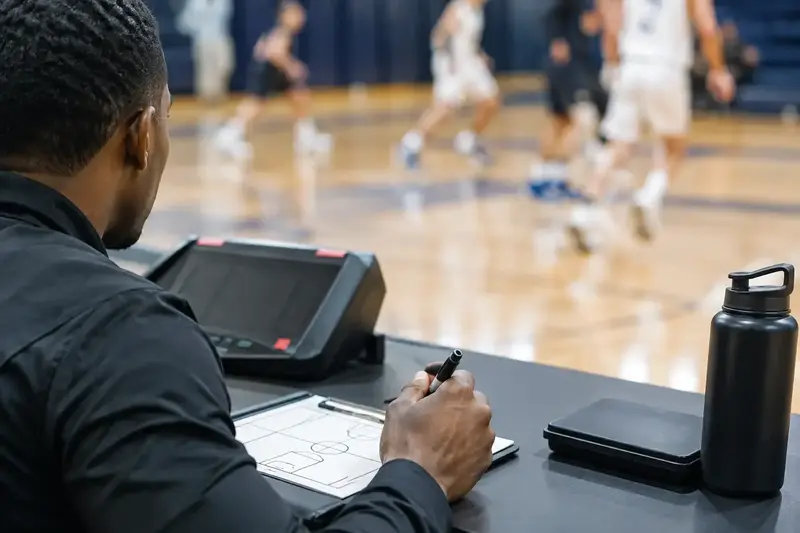
A timeout is a short stoppage with outsized operational consequences. If the scorer records the wrong team, misses a timeout, or cannot quickly confirm how many remain, the error reaches the bench, the officials table, the broadcast, and eventually the final game record. To track timeouts during basketball games accurately, leagues need a defined live-scoring workflow that treats each timeout as an official event, not a note added after the game.
For local leagues and tournament operators, that workflow must also account for rule variations. A youth event may follow NFHS rules, an adult league may use modified NBA timing, and an international competition may use FIBA regulations. The scorekeeper needs the correct allowance before the opening tip, along with a clear method for recording, displaying, and reconciling every timeout.
Start With the Competition's Timeout Rules
Timeout tracking begins before the game clock starts. Confirm the timeout format in the competition rules and make it visible to the scorekeeper and table crew. The critical details are the number of timeouts per team, timeout duration, whether timeouts carry over between halves or periods, and any restrictions in the final minutes.
This matters because basketball timeout rules are not universal. NBA games use a different structure from NCAA, NFHS, and FIBA games. Even within independent leagues, operators may set their own rules to fit a two-hour gym block, a showcase schedule, or a broadcast window. A scorer should never need to infer the allowance from memory while a coach is standing at the table.
For tournament play, document whether the timeout rule changes in overtime. Also establish who has final authority if a discrepancy arises. In most settings, the referee makes the on-court ruling, while the official scorer provides the recorded timeout count. That division keeps the table organized when a question is raised late in a close game.
Build a Live Workflow to Track Timeouts During Basketball Games
The most reliable process is simple: record the timeout immediately when it is recognized, verify the requesting team, and update the remaining count before play resumes. Delaying the entry until the next dead ball creates avoidable risk, especially if substitutions, fouls, or media activity occur during the same stoppage.
Record the Event at the Moment of Recognition
When an official grants a timeout, the scorer should identify the team and enter it as a timestamped event in the live scorekeeping system. The entry should be tied to the current period and game-clock time. This creates a play-by-play record that can later explain exactly when the timeout was used.
A good timeout event does more than decrement a number. It establishes an auditable record for the scorekeeper, league administrator, and anyone reviewing the game afterward. If a coach believes a timeout was incorrectly charged, the table can check the event history rather than reconstruct the sequence from memory.
The scorer should not wait for the timeout to end before entering it. Coaches may use the stoppage to discuss strategy, broadcasters may shift to a break, and the crew may manage substitutions. Recording early gives the table time to confirm the remaining count without competing with those tasks.
Keep the Remaining Count Visible
The team bench needs a fast answer when it asks, “How many do we have?” So do the officials. Keep each team’s remaining timeout total visible in the scorekeeping interface and, where your game presentation supports it, in a table-facing display or broadcast overlay.
Visibility is useful, but it does not replace communication. If the game reaches a point where timeout availability is likely to matter, such as the final two minutes, the scorer should be ready to confirm the count with the nearest official. Quiet confirmation during a normal stoppage is better than a public dispute after an invalid timeout request.
For leagues producing streams, timeout totals can also be displayed in an OBS browser-source overlay. That gives viewers context during late-game possessions without forcing production staff to maintain a separate spreadsheet or manually update graphics.
Separate Charged Timeouts From Administrative Stoppages
Not every stoppage is a charged team timeout. Injury delays, equipment issues, official reviews, clock corrections, and other administrative interruptions may stop the game without reducing either team’s allowance. The scorer must record these events clearly and avoid charging a timeout unless the official has designated one.
This is where loosely managed games often go wrong. A coach may walk onto the floor during an injury delay, the bench may huddle, and someone may assume a timeout was used. The official scorer should follow the referee’s signal and the league rulebook, not the appearance of the stoppage.
If your league allows a coach to request a timeout through a table official, set a consistent acknowledgement procedure. The request should be recognized by the official, communicated to the scorer, and recorded only after it has been granted. A request that is not granted is not a timeout event.
Coordinate the Table, Officials, and Broadcast Crew
Timeout accuracy is a shared operational responsibility, but one person must own the official record. Assign that responsibility before each game. In a basic setup, the scorekeeper owns timeout entries while the clock operator manages the game clock and timeout duration. In a larger production, a statistician or live-data operator may enter events, with the official scorer validating them.
Before the first game of a season or tournament, run a short table-crew briefing. Confirm the timeout rules, hand signals, communication expectations, and escalation path for corrections. This is particularly valuable when volunteers rotate between games or when a league brings together crews with different experience levels.
The broadcast team should receive data from the same scoring source used by the official table. If the stream producer is manually tracking timeouts independently, discrepancies are almost guaranteed over a full season. A connected workflow allows the live event feed to drive fan-facing graphics, live scores, and play-by-play from one record of the game.
Correct Mistakes Without Losing the Audit Trail
Mistakes happen. The key is to correct them promptly and preserve a clear record of what changed. If the scorer accidentally charges Team A instead of Team B, make the correction in the scoring system rather than adjusting an unrelated later event to compensate.
When a correction affects the remaining count, notify the referee at the next practical dead ball. If a graphic or public live page showed the incorrect total, the corrected live data should update immediately. That is one reason centralized game management is preferable to separate paper notes, social posts, and broadcast graphics.
After the game, reconcile timeout events against the official book before publishing a finalized box score. Timeouts may not be a traditional player statistic, but their event history affects the credibility of the entire game record. A reconciled game report is especially important in playoff games, protests, and games with close end-of-period situations.
Use Technology to Reduce Table Pressure
Paper scorebooks can work, but they put more pressure on the scorekeeper to maintain several parallel records. A modern live-scoring platform can show each team’s timeout balance, store a timestamped event log, distribute updates to public game pages, and feed streaming overlays from the same source.
With bbstats.am, a league can record timeout events alongside scoring, fouls, substitutions, and clock activity in a single live game workflow. The result is more than a cleaner table operation. Supporters receive real-time game updates, media staff work from current data, and administrators retain a consistent record after the final horn.
Technology still depends on disciplined operators. Configure each competition’s timeout rules in advance, train the people at the table, and make sure the device running live scoring has reliable power and connectivity. For venues with uncertain internet access, establish a backup process and reconcile the live record as soon as service is restored.
A Practical Timeout Checklist for Close Games
The final minutes create the highest risk because every possession, substitution, and clock adjustment carries more weight. The scorer should monitor the timeout totals after every charged timeout, confirm the period and clock timestamp, and be ready to answer the officials immediately.
For tournament directors, it also helps to review timeout handling after the first round of games. If multiple table crews are using different interpretations, correct the process before the bracket reaches elimination rounds. Consistency is part of competitive fairness.
A well-run timeout process should feel almost invisible to everyone outside the table. Coaches get accurate answers, officials can make confident rulings, broadcasters show current information, and fans follow the game without seeing the operational work behind it. That is the standard worth building toward before the next close finish makes every remaining timeout matter.