
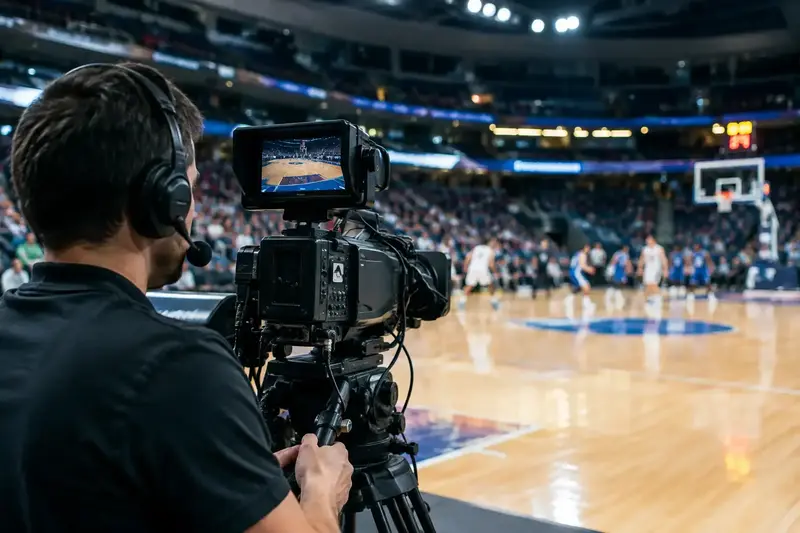
A close game should not leave fans refreshing a spreadsheet, waiting for a social post, or watching a stream with a scoreboard that is two possessions behind. The most useful basketball broadcast technology trends are not reserved for national networks. They are becoming practical for independent leagues because live scoring, web publishing, graphics, and streaming can now share the same game data.
For league operators, the point is not to add more production tools. It is to establish one reliable event record: a scorekeeper records a made three, the game clock advances, the public scoreboard updates, the play appears in the feed, and the broadcast overlay reflects the new score. When those actions depend on separate people and separate systems, accuracy suffers at exactly the moments fans are paying attention.
Basketball Broadcast Technology Trends That Matter
The market is full of impressive camera hardware, automated clipping tools, and AI-assisted production products. Some are valuable. But local, youth, recreational, school, and semi-professional leagues get the greatest operational benefit from technology that improves data quality, speed, and consistency before it adds production complexity.
Live data is becoming the broadcast control layer
A live broadcast graphic used to be manually operated from a production laptop. An operator watched the game, entered the score, changed the clock, updated fouls, and tried to keep pace with the action. That setup can still work, particularly for a simple single-camera stream. It also creates two versions of the truth if the official scorekeeper uses a separate scoring application.
The stronger approach is to let official game events power the graphic. Live play-by-play data can be delivered over a WebSocket connection to a browser-source overlay in OBS or another production system. When a scorekeeper records a field goal, free throw, timeout, foul, or substitution, the overlay receives the update automatically.
This is a meaningful shift because it reduces duplicate entry. The production crew can focus on camera direction, commentary, replays, and sponsor reads instead of acting as a second scorekeeping team. The league also has a clearer audit trail when a score or player statistic needs to be reviewed after the game.
There is a trade-off. Data-driven graphics only look reliable when scorekeepers have a disciplined workflow and a clear procedure for corrections. A poorly trained scorer can publish mistakes faster. Leagues should treat scorer onboarding, device readiness, and game-day support as part of broadcast preparation, not as separate administrative tasks.
Browser-based overlays are replacing custom graphics builds
Modern streaming workflows increasingly rely on browser-source overlays. Rather than building every scoreboard in a specialized graphics package, a league can load a hosted overlay URL into OBS, position it over the video feed, and apply its branding through configurable colors, logos, and typography.
For smaller organizations, this matters because the same system can support a basic gym stream and a more ambitious championship broadcast. A volunteer may run a camera and a single scoreboard overlay during the regular season. For the final, the media team can add a lower third, player-stat panel, possession indicator, or rotating sponsor placement without changing the game-data source.
The best overlay is not necessarily the busiest one. A scoreboard should be legible on a phone screen, show period and clock clearly, and match the official score at all times. Player stats and animated elements can improve a broadcast, but only if they do not block live action or require manual intervention that a lean crew cannot sustain.
Real-time statistics are moving from postgame content to live context
Fans increasingly expect more than a score. They want to know who has 18 points, whether a player is in foul trouble, how a team is shooting, and what the result means for the standings. This is where live scorekeeping becomes a publishing engine instead of a back-office task.
During a game, a league can make the live box score, play-by-play, team totals, and player lines available on its public site. After the final horn, those records should reconcile into the official result, update season statistics, and affect league standings without an administrator retyping data into another system.
That connection becomes especially valuable in tournaments and playoffs. A quarterfinal result can automatically advance the winning team into a bracket. In a best-of-3 series, the series score can reflect the completed game and reveal the next scheduled matchup. Media staff can reference the same standings and bracket fans see, which avoids contradictory information across the stream, website, and social channels.
Not every statistic needs to be live. Advanced metrics can be published after review if they depend on video tagging or additional validation. The essential standard is simpler: the score, clock, fouls, and core box score should be timely, explainable, and consistent wherever they appear.
Production Is Becoming More Distributed
Remote production is another practical trend. A game can be streamed from a gym while a graphics operator, commentator, or social-media coordinator works elsewhere. This setup can reduce travel and make regional coverage more feasible, but it changes the technical checklist.
Internet reliability is the first constraint. A venue may have excellent download speed but limited upload capacity, congested Wi-Fi, or network policies that interfere with production devices. Leagues should test upload bandwidth from the actual court location, use a wired connection when possible, and keep a cellular backup available for important games.
Clock synchronization also deserves attention. Video naturally carries latency, especially when sent through public streaming platforms. If a scoreboard overlay is driven by real-time scoring data while the video is delayed, viewers may see the score update before the basket appears on screen. Some delay is unavoidable, but operators can reduce confusion by configuring appropriate broadcast delay and avoiding aggressive low-latency settings unless the full workflow supports them.
Communication is the other requirement. Remote crews need a defined game-day channel for clock issues, scorer corrections, media timeouts, and technical failures. A short pregame check between the scorekeeper and producer prevents many visible mistakes. Confirm team names, jersey numbers, starters, period length, overtime rules, and the overlay connection before tipoff.
Automated highlights need verified source data
Automated highlight generation is improving, especially when a system can combine game events with video timestamps. A made basket, block, or late-game lead change can become a candidate clip without someone reviewing the full recording from start to finish.
That is useful for organizations with limited media staff, but it is not magic. An event timestamp must correspond closely to the video timeline. Camera placement, stream delay, interruptions, and manual scorer corrections can all affect clip accuracy. Automated clips should be reviewed before they are used for official promotion, particularly around controversial plays or player recognition.
The practical opportunity is to use automation for volume, then use people for judgment. A league can publish a quick set of candidate moments after a game while saving polished recaps for games that merit more editorial attention.
How to Build a Practical Broadcast Stack
Start with the official game record, not the camera. A good baseline includes live scorekeeping with NBA-style clocks and play-by-play, a public league site for schedules and results, and an OBS browser-source overlay connected to live game data. That foundation supports a credible stream even when the crew is small.
Next, decide what must happen automatically. Scores, period, game clock, fouls, standings, and playoff advancement are strong candidates because manual repetition creates errors. Brand elements, announcer lower thirds, sponsored segments, and special graphics may remain under production control because they depend on editorial timing.
Then test the workflow under real conditions. Run a mock game with the same scorer device, venue network, OBS scene collection, and streaming destination you will use on game day. Test a correction: change a made two to a made three, verify the box score updates, and confirm the overlay receives the revised total. Test period transitions and overtime as well. Small failures are easier to fix in a rehearsal than in the final minute of a rivalry game.
A platform such as bbstats.am can centralize that workflow by connecting live scoring, public game pages, league standings, brackets, and streaming-ready overlays within a league's own branded tenant. It can also reduce the friction of publishing official results when operators need to import FIBA or GENIUS PDF box scores after games scored elsewhere.
Where Human Control Still Wins
Technology can make a local league look more professional, but it cannot replace decisions about accuracy and presentation. An official scorer must still resolve uncertain plays. A commissioner must still decide how to correct a protested result. A producer must still choose when a graphic helps the audience and when it distracts from the game.
The most durable setup is not the one with the most automation. It is the one that gives each role a clear source of truth, limits duplicate entry, and remains usable when a volunteer is operating under pressure. Build around the game record, rehearse the handoffs, and let every published score earn fan trust possession by possession.