
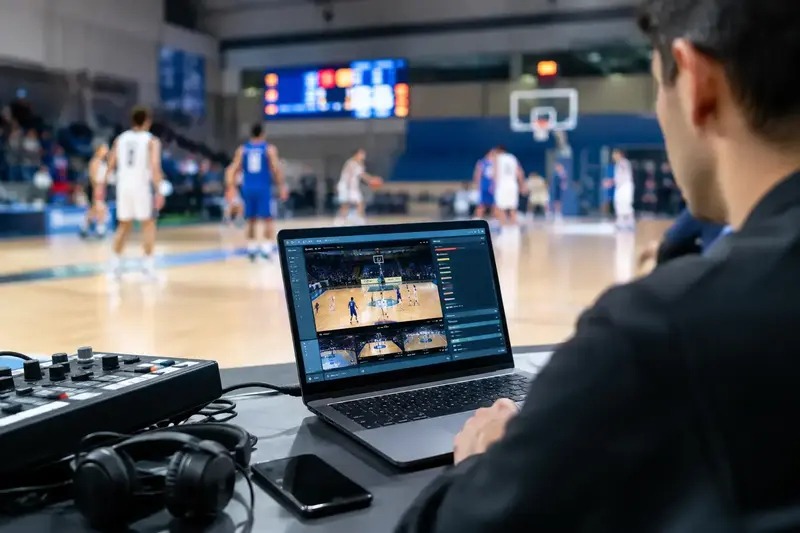
A one-point game with 18 seconds left is not the moment for a scorekeeper to calculate fouls on paper, a commissioner to update a website manually, and fans to refresh a social feed for the final result. Live scoreboards give every person around the game the same current picture: the score, period, clock, fouls, timeouts, and the play that just changed momentum.
For a basketball league, that visibility is more than presentation. It is the public output of an operating system that begins with accurate scorekeeper inputs and ends with reconciled box scores, updated standings, and a credible league record.
What live scoreboards need to show
A basketball scoreboard has a basic job: make the game state readable at a glance. The home and away score, current period, game clock, and shot clock must be clear enough for players, coaches, officials, media staff, and spectators to trust immediately. But a usable live scoreboard for league operations needs to carry more context.
Team fouls, player fouls, timeouts, possession indicators, bonus status, and overtime periods affect coaching decisions and game administration. When those details are visible and synchronized with the official scorekeeping workflow, the scoreboard is not merely decorative. It becomes a shared reference point for the bench, scorer's table, broadcast crew, and audience.
The difference is especially clear during close games. A display that updates only after a manual website edit may look acceptable in a postgame recap. It does not support real-time decisions. A live system should reflect each validated scoring event as it is recorded, while the game clock continues to run on the scorer's control.
The scoreboard is only as reliable as the scoring workflow
The most attractive display cannot repair incomplete or inconsistent game data. Leagues should start by examining how a basket, foul, substitution, timeout, or correction travels from the scorer's table to the public scoreboard.
In a sound workflow, the scorekeeper records the event once. That event updates the score, player statistics, team totals, play-by-play, and public game view from the same source of truth. A made three-point field goal should not require one entry in a scoring app, another in a spreadsheet, and a third on a website after the game.
This approach also makes corrections manageable. Scorekeepers occasionally need to reverse a basket, assign a foul to a different player, or fix an incorrectly recorded free throw. When game components are connected, an authorized correction updates the related totals rather than leaving conflicting numbers across the box score, standings page, and broadcast graphic.
There is a trade-off. Real-time publishing makes errors visible faster if operators have not trained scorekeepers or defined an approval process. For youth and recreational leagues with volunteer staff, a simple scoring screen and a short pregame checklist often matter more than advanced reporting. For competitive leagues with trained table crews, detailed play-by-play and immediate public updates may be the right standard. The system should match the level of the operation without creating duplicate work.
Why clocks require more than a timer widget
Basketball clocks are operational equipment, not just interface elements. A league's live game view must distinguish between a running game clock, a stopped clock, period breaks, timeouts, and shot-clock resets. If the shot clock is displayed, it must follow the rules used by that competition, including offensive rebounds and late-game possession changes.
NBA-style clock controls can help scorekeepers work in a familiar pattern, but the value comes from disciplined use. Establish who starts and stops the game clock, who confirms period transitions, and who has authority to make corrections. If the venue uses a physical scoreboard, decide whether the digital scorekeeping screen is the official record, a parallel record, or a display feed tied to the venue equipment.
A real-time platform should also tolerate normal venue conditions. Wi-Fi can be weak, courts can be noisy, and a volunteer may need to take over midgame. Clear permissions, autosaved game state, and a practical recovery process reduce the impact of those realities. The goal is not to promise that nothing ever goes wrong. It is to ensure a small interruption does not become a lost box score.
Live scoreboards should update every audience at once
A scorekeeper needs controls. A coach needs the game state. A parent may need a mobile-friendly score update from another city. A media volunteer needs a clean broadcast graphic. These are different views of the same game, and they should not require four separate publishing processes.
With WebSocket event delivery, a recorded play can reach the public game page in real time. A fan following a league site sees the score move without refreshing the page. The play-by-play can show that a player made two free throws or committed a fourth foul, giving context that a final score alone cannot provide.
For streaming, an OBS browser-source overlay can use the same live data to display team names, score, clock, player statistics, or lower-third updates. That removes the common problem of a broadcast operator manually changing graphics while the scorekeeper independently records the official game. It also gives smaller leagues a professional production path without buying a separate graphics workflow.
The audience benefit is immediate, but the administrative benefit lasts longer. Live games become finished games with published records. When the final horn sounds, supporters can find the result, box score, schedule implications, and standings without waiting for someone to rebuild the information later that night.
Connect game results to the rest of the league
A live game page is most valuable when it is connected to the league structure around it. Final scores should advance standings based on the competition's configured rules. Player totals should flow into season leaders. Completed games should appear in team schedules and results. If the game is part of a playoff series, the bracket should reflect the result and reveal the next matchup when the series conditions are met.
This matters for best-of-3 formats, where one result does not always decide advancement. A league platform should track series wins rather than treating every playoff game as an isolated result. Once a team reaches the required number of wins, the bracket can update automatically, reducing the chance that staff publish an outdated matchup.
Imported official records also belong in this workflow. Some leagues receive FIBA or Genius PDF box scores from tournaments, venues, or partner organizations. Import tools can preserve the season record without forcing administrators to retype every player line. The import should be reviewed, matched to the correct teams and roster identities, and then published as part of the same statistics and standings environment.
Choose a setup that supports your actual game day
Before selecting a scoreboard system, map a typical game from warmups through final publication. Identify the device at the scorer's table, the network available in the gym, the people who will score the game, and where fans will expect to see results. Then test the full sequence with a real roster and a sample game, not just an empty demo screen.
Look for operational details that are easy to overlook: can administrators correct a completed game with proper permissions, can the league retain its own visual identity, and can fans receive push or email notifications for results and schedule changes? If you plan to stream, test the overlay with your production workflow before opening night. If you use a custom domain, verify that HTTPS is configured automatically and that the public site remains clearly branded as your league.
A multi-tenant platform such as bbstats.am can give each league its own isolated workspace, branded public site, live scoring controls, statistics, brackets, notifications, and streaming-ready outputs. That reduces the need to connect separate spreadsheets, scoring tools, website builders, and broadcast graphics under game-day pressure.
A practical game-day standard
The right standard for live scoreboards is simple: record the game once, make the current game state visible where it is needed, and preserve an official record after the final horn. Build the process around trained people and realistic venue conditions, then let the technology carry the update through the scoreboard, fan site, statistics, standings, and broadcast.
When a league can publish a close finish accurately while the crowd is still reacting, it does more than look professional. It gives teams, supporters, and partners a reason to treat the competition like the organized program it is.