
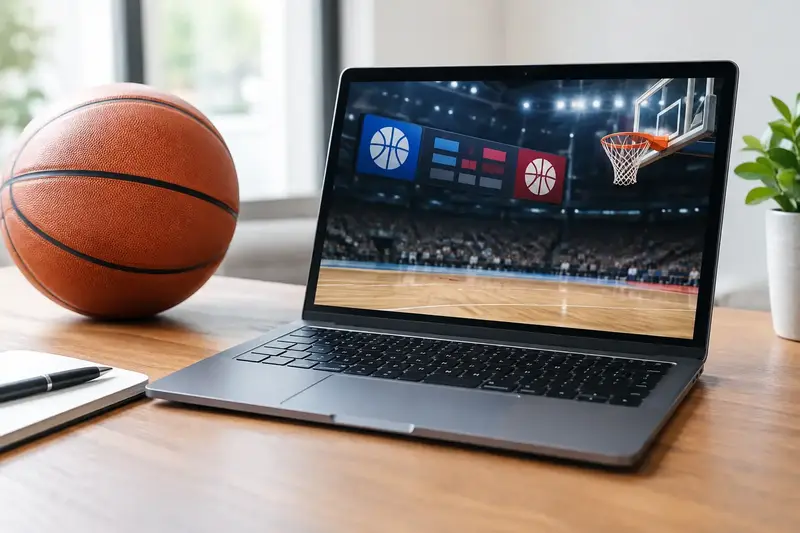
A scoreboard can look polished in OBS and still fail the people who matter most: the scorekeeper entering a correction, the commentator calling a late timeout, and the fan checking whether a three-point play counted. A useful streaming scoreboard evaluation tests the full chain from courtside input to the public broadcast, not just the visual design of the overlay.
For basketball league operators, that distinction is operational. The score, clock, fouls, possession, player stats, and game status must agree across the scorer’s console, the public game page, and the stream. If they do not, the broadcast becomes a second, unreliable version of the game.
What a Streaming Scoreboard Evaluation Should Measure
A streaming scoreboard is not a standalone graphic. It is the visible endpoint of a live-data workflow that begins with scorekeeping. The evaluation should therefore ask whether the system produces accurate data, moves it quickly, displays it clearly, and remains manageable when a real game becomes messy.
The first question is data authority. Identify which system is the official source for score, clock, player fouls, and team fouls. A production crew should not be manually typing the score into a graphics tool while a scorekeeper maintains a separate official record. That creates two timelines, and they will eventually diverge after a correction, timeout, or scoring review.
The second question is update latency. A one- or two-second delay may be acceptable for an audience watching a live stream, especially where video encoding already adds delay. A delay that leaves the score wrong through the next possession is not. Test the time from a recorded scoring event to the browser-source overlay update, including the behavior after an internet interruption or a refreshed broadcast computer.
The third question is clarity. Fans need the information that helps them follow the game without crowding the camera view. At minimum, evaluate team names or abbreviations, scores, period, game clock, shot clock where applicable, timeouts when relevant, and possession indicator if your competition uses one. Ensure contrast remains readable against both a bright court and a dark crowd background.
Evaluate the Scorekeeping-to-Overlay Workflow
The strongest streaming setups use one event record for every audience-facing output. When a scorekeeper logs a made field goal, that event should update the game total, player statistics, play-by-play, public game center, standings inputs, and broadcast overlay from the same source.
This is where a live scoring platform has a material advantage over a manually maintained streaming graphic. It removes a duplicate production task and makes corrections visible everywhere. If a scorer changes a two-point basket to a three after review, the overlay should reconcile with the official box score rather than wait for a producer to notice the discrepancy.
Test normal play, not just a pregame preview
A static overlay preview proves very little. Run a controlled game test that includes routine scoring, substitutions, team fouls, timeouts, quarter transitions, and halftime. Then test conditions that expose weak workflows: a mistaken player assignment, a corrected score, a clock adjustment, an overtime period, and a temporary loss of connectivity.
Watch whether the overlay reflects each update correctly and whether the scoring operator can keep working without needing to coordinate every action with the stream producer. A system that performs well only when two experienced staff members are constantly messaging each other is not ready for a volunteer-run league night.
Check clock ownership carefully
Clock data deserves separate attention because it is the most visible live element and the easiest to mishandle. Decide whether the official game clock is entered manually by the scorekeeper, controlled through a dedicated timing device, or mirrored from a courtside operator. Do not imply frame-level synchronization with the video unless your workflow has been engineered and tested for it.
For many youth, recreational, and independent leagues, accurate scoreboard state is more important than perfect video-clock alignment. A browser-source scoreboard that clearly shows the official clock and updates consistently is preferable to a visually impressive clock that drifts or freezes during critical possessions.
Assess the Broadcast Overlay as a Production Tool
Once the data is dependable, evaluate the overlay as part of the broadcast crew’s workflow. Most leagues use OBS or similar production software, where a browser-source overlay is added to a scene. The producer should be able to load the correct game, confirm the live preview, and switch scenes without editing scores by hand.
A practical overlay should support your league’s visual identity without forcing a custom graphics build before every event. Review team colors, logo handling, long-name behavior, font sizes, and layouts for both desktop and mobile viewers. A team name that fits in a test environment but truncates during a tournament semifinal is a preventable production issue.
Also consider what happens across multiple games. Tournament organizers often move quickly from one court or matchup to the next. The production team needs a clear way to select the current game and verify that the overlay is connected to it. A stale scoreboard from the prior game is more damaging than no overlay because it misleads viewers with confidence.
Use a Realistic Evaluation Checklist
Before adopting or expanding a streaming workflow, run the following checks during a live simulation or lower-risk regular-season game:
- Confirm that scoring events update the official game record, public game page, and overlay from one source.
- Measure update timing during made baskets, fouls, substitutions, timeouts, and score corrections.
- Test browser-source loading, refresh behavior, and reconnection after a local network interruption.
- Verify readability on the actual stream output, including mobile viewing and camera angles with bright court lighting.
- Confirm that the final published box score matches the scoreboard state shown at the end of the game.
These checks reveal more than a vendor demo can. They show whether the system works with the personnel, internet quality, hardware, and game procedures your league actually has.
Consider the Operational Trade-Offs
Not every league needs the same level of production. A weekend recreational league streaming one court may prioritize fast setup, clear score display, and reliable final stats. A regional competition with commentators, multiple courts, sponsors, and playoff broadcasts may require branded layouts, separate scene packages, and a more formal production role.
The right choice also depends on staffing. If your broadcast team is small, the platform should reduce manual steps. If you have a dedicated producer, you may want more scene control and presentation options. In both cases, the official scoring workflow must remain protected from broadcast demands. The scorekeeper’s job is to record the game accurately, not to operate a graphics workstation.
Internet architecture matters as well. A stable venue connection is helpful, but plan for imperfect conditions. Test whether the scoring device can continue capturing events during a brief interruption, what data remains visible on the overlay, and how the system reconciles once service returns. Document the fallback process for operators before a championship game, not during one.
Connect Streaming to the Fan Experience
A scoreboard overlay should reinforce the league’s public record, not replace it. Fans who miss the live broadcast will still expect to find the final score, player totals, play-by-play, standings impact, and next scheduled game in the same branded destination.
That is why platforms such as bbstats.am connect live scorekeeping with public league websites, real-time game data, standings, brackets, and streaming-ready browser overlays. The practical value is not simply a better lower third on video. It is one reconciled game record that serves operators, broadcasters, players, and supporters at the same time.
A completed streaming scoreboard evaluation should leave your crew with a repeatable game-night procedure: who starts the game, who verifies the overlay, how corrections are handled, and where fans find the official result afterward. When that process is clear, the broadcast can feel professional without adding another fragile system to manage.