
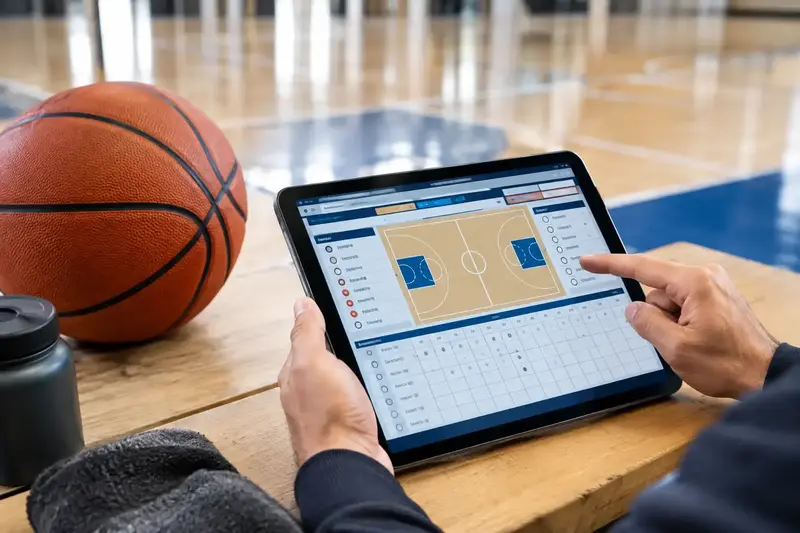
A disputed fourth-quarter foul should not create a second dispute after the game. Yet many leagues still run scoring through a mix of paper sheets, a scoring app, spreadsheet corrections, and manually updated standings. The best digital basketball scoresheets replace that chain with one reliable game record: every event is captured once, reviewed by the scorer, and used everywhere the league needs it.
For a league operator, the question is not simply whether a tool can count points. It is whether it can support the complete workflow around a game - the clock, player fouls, substitutions, box score, standings, playoff advancement, public results, and broadcast output. The right system gives scorekeepers a focused working screen while giving commissioners and fans accurate information without waiting for someone to re-enter it later.
What makes a digital scoresheet league-ready?
A digital scoresheet becomes operationally useful when it treats the game as a sequence of structured events, not just a final-score form. A made three-pointer, shooting foul, timeout, substitution, technical foul, and period change should each be recorded in a way that updates the appropriate totals immediately.
That event-level record matters because basketball statistics are connected. A player’s points must agree with their made field goals and free throws. Team fouls affect the bonus. Player fouls affect eligibility. Possession and clock state affect what can happen next. If a correction is needed, the system should reconcile the box score rather than leaving an administrator to search through several files after the gym is empty.
A league-ready scoresheet should also separate two needs that are often confused: scoring a game and publishing a league. A scorekeeping-only app may work at courtside, but it can still leave staff exporting results, updating standings, building brackets, and posting recaps elsewhere. That is manageable for a one-day event. It becomes a recurring workload over a season with multiple divisions, postponed games, and playoffs.
Live data must have a destination
Real-time scoring has value only when the update reaches the people who need it. At minimum, the public game page should refresh as the scorer records events. Better systems also carry the same live data to team pages, player leaders, standings, schedules, and game notifications.
For media staff, the same event feed can power a streaming overlay through an OBS browser source. That avoids the common production setup where one person watches the scorer’s screen and manually changes a separate graphic. When a score, period, or timeout changes, the overlay should reflect the official game state.
The clock is not a minor feature
Basketball scoring software should account for the realities of the scorer’s table: period length, overtime, shot-clock workflow where applicable, team timeouts, possession indicators, and clock adjustments. A game clock that looks good in a demo but is difficult to correct under pressure is a liability.
NBA-style clock controls can be valuable for leagues that want a familiar table experience, but the interface still needs to be practical for volunteer scorekeepers. Large, clear controls and reversible actions are usually more useful than a crowded screen full of rarely used options. The best choice depends on the level of competition and the number of trained table officials available.
How to evaluate the best digital basketball scoresheets
Start with the specific problems your league needs to solve. A youth recreation program may prioritize fast setup, roster management, and a clear public schedule. A regional semi-pro league may need detailed play-by-play, statistical leaders, white-label publishing, live notifications, and broadcast graphics. Neither requirement is less legitimate, but they point to different feature priorities.
Use a real game workflow when evaluating software. Build two teams with actual rosters, start a test game, enter substitutions and fouls, correct an accidental basket, finish overtime, and inspect the published result. Then ask what happens when a game is postponed, a player transfers, or a playoff series reaches a deciding game. Those are the moments that reveal whether a product is designed for league operations or only for basic score entry.
Look closely at these four areas:
- Game entry and corrections: Scorekeepers should be able to record common events quickly and reverse or edit mistakes with an audit-friendly result. The final box score should remain internally consistent after corrections.
- Statistics and records: The system should calculate player and team statistics from game data, retain historical results, and make leaders understandable to the public. Imported official box scores should fit the same statistical record.
- Competition management: Schedules, standings, divisions, tiebreakers, and playoff brackets should use game results directly. For a best-of-3 series, each completed game should advance the series state without manual bracket rebuilding.
- Publishing and communications: Fans should have a reliable destination for scores, schedules, rosters, stats, and brackets. Real-time updates, email or push notifications, custom branding, and a custom domain may matter as much as the scorer interface.
A product that performs strongly in only one area can still be the right purchase. A school that already has a mature athletics website may only need a courtside scoring tool. But if your staff is maintaining several disconnected systems, the administrative cost is part of the comparison even when it does not appear on the subscription invoice.
Standalone scorekeeping versus an integrated platform
Standalone digital scoresheets are often easy to adopt. They can be a sensible choice for occasional tournaments, scrimmages, or organizations that only need a PDF-style box score after each game. Their trade-off is what happens next: results may need to be exported, entered into a website, used to update standings, and reformatted for social or streaming.
An integrated platform treats the completed game as the source of truth for the league. When the scorer finalizes the game, standings can update automatically, a playoff bracket can advance, player statistics can refresh, and supporters can see the result on the league’s branded public site. This reduces duplicate entry and makes it easier to identify which result is official.
That model is especially useful for organizations operating multiple leagues or divisions. A multi-tenant platform gives each league its own isolated workspace, visual identity, and public subdomain while allowing the operator to maintain a consistent workflow. Optional custom domains and automatic HTTPS help smaller leagues present themselves with the same level of credibility supporters expect from established competitions.
bbstats.am is designed around this connected model: live scorekeeping, NBA-style clocks, real-time play-by-play, standings, brackets, and public publishing operate from the same league data. It also supports FIBA/GENIUS PDF box-score imports, which matters when a league needs to preserve official statistics from games scored through another approved process.
Questions to ask before committing
Ask who will score games and how much training they can reasonably receive. A platform with extensive controls can be appropriate for experienced table crews, while a volunteer-led league may need a more guided workflow. Request a shared demo or run a controlled test with an actual scorekeeper rather than evaluating only an administrator view.
Ask how the system handles connectivity issues, corrections after publication, and data retention. Gym Wi-Fi is not always dependable, and a league needs a clear process for verifying the official box score. Backup retention and access controls are not glamorous features, but they become critical when a standings dispute arises weeks later.
Also ask whether public presentation is included or treated as an afterthought. A scoresheet can be technically accurate while the fan experience remains poor if schedules are hard to find, score updates are delayed, and statistics are buried in exports. If your league sells sponsorships, streams games, or wants to grow registrations, the public-facing layer is part of the product requirement.
Set up a workflow your scorekeepers can trust
The strongest implementation starts before opening night. Confirm roster names and jersey numbers, define competition rules, set period and overtime settings, and decide who can finalize or amend games. Run one preseason game with the full workflow, including a test of the public game page and any OBS overlay. That rehearsal is the right place to find a missing player, an unclear timeout rule, or a clock control that needs training.
During the season, give scorekeepers one clear rule: record the game as it happens, then reconcile the final score and key totals before finalizing. Give administrators a separate rule: correct official data in the system of record, not in a spreadsheet copied from it. Those two habits prevent most version-control problems.
A digital scoresheet earns its place when it reduces work after the buzzer, not when it adds another screen to manage. Choose the system that lets your staff focus on a well-run game while every verified event carries forward into the league experience your players and supporters see.